
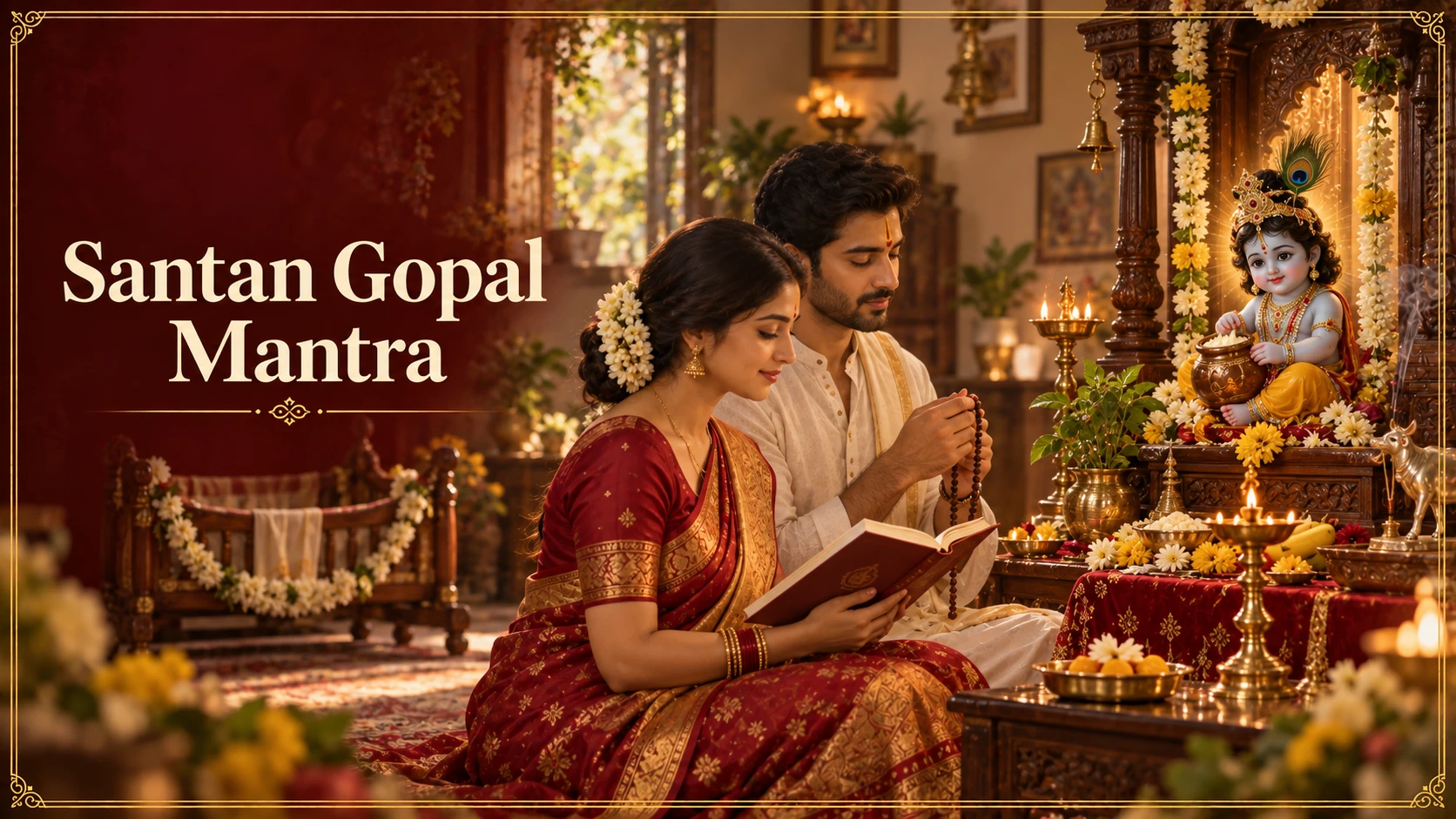
The Santan Gopal Mantra is a sacred prayer dedicated to Lord Krishna in his divine child form, known as Bal Gopal or Santan Gopal. In Sanatan tradition, devotees chant this mantra while praying for the blessing and well-being of children, family happiness, emotional strength and divine guidance during their journey towards parenthood.
This detailed guide provides the Santan Gopal Mantra in Sanskrit, English transliteration, Hindi and English meanings, traditional benefits, correct chanting procedure, jaap count, suitable time, important rules and answers to commonly searched questions.
The mantra should be practised with devotion and patience, without treating it as a guaranteed method of conception or a replacement for professional medical care.
The Santan Gopal Mantra is an invocation to Lord Krishna as Devaki’s divine son, Govinda, Vasudeva and the Lord of the universe. Through its words, the devotee seeks refuge in Krishna and humbly prays for the blessing of a child.
The word Santan refers to offspring or children, while Gopal is a revered name of Lord Krishna. Santan Gopal therefore represents Krishna’s sacred child form and symbolises innocence, parental affection, hope, protection and family joy.
The mantra is also written as Santana Gopala Mantra or Santhana Gopala Mantra in some regional traditions. However, “Santan Gopal Mantra” is the commonly searched English spelling.
ॐ देवकीसुत गोविन्द वासुदेव जगत्पते।
देहि मे तनयं कृष्ण त्वामहं शरणं गतः॥
Om Devaki-Suta Govinda Vasudeva Jagatpate,
Dehi Me Tanayam Krishna Tvamaham Sharanam Gatah.
A simple pronunciation guide is:
Om De-va-kee Su-ta Go-vin-da, Vaa-su-de-va Ja-gat-pa-te,
De-hi Me Ta-na-yam Krish-na, Tvaa-ma-ham Sha-ra-nam Ga-tah.
Chant slowly and clearly. Do not hurry merely to complete a particular number. If you are undertaking a formal mantra anushthan, learn the accepted pronunciation from a knowledgeable spiritual guide.
| Sanskrit expression | Meaning |
|---|---|
| Om | The sacred primordial sound |
| Devaki-Suta | Son of Devaki |
| Govinda | A revered name of Lord Krishna |
| Vasudeva | Son of Vasudeva; the all-pervading Lord |
| Jagatpate | Lord of the universe |
| Dehi Me | Please grant me |
| Tanayam | A child or offspring |
| Krishna | Lord Krishna |
| Tvam Aham | I seek you |
| Sharanam Gatah | I have taken refuge in you |
हे देवकीनंदन भगवान गोविंद, हे वासुदेव, हे संपूर्ण जगत के स्वामी श्रीकृष्ण! मैं आपकी शरण में आया/आई हूं। कृपया मुझे संतान का आशीर्वाद प्रदान करें।
इस मंत्र में भक्त भगवान श्रीकृष्ण से केवल अपनी इच्छा पूरी करने की प्रार्थना नहीं करता, बल्कि स्वयं को उनकी शरण में समर्पित करता है। इसका भाव श्रद्धा, विनम्रता, धैर्य और ईश्वर पर विश्वास से जुड़ा है।
“O Lord Govinda, divine son of Devaki, O Vasudeva and Lord of the universe, I seek refuge in you. O Krishna, please bless me with a child.”
The deeper spiritual meaning of the mantra is surrender. It encourages devotees to combine prayer with patience, responsibility, mutual family support and faith in divine guidance.
Bal Gopal represents the innocent and joyful childhood form of Lord Krishna. His stories reflect affection, protection, playfulness and the sacred relationship between parents and children.
Chanting the Santan Gopal Mantra reminds devotees that parenthood involves more than the desire to have a child. It also requires patience, responsibility, compassion, emotional maturity and unconditional care.
The mantra is traditionally associated with:
These are traditional devotional beliefs and must not be presented as guaranteed medical outcomes.
The mantra invokes Krishna as Devaki’s son and the Lord of the universe. Regular chanting can deepen devotion, humility and spiritual surrender.
Couples traditionally recite the mantra while praying for the blessing, protection and well-being of children.
A consistent chanting practice can provide a peaceful period for reflection and may help devotees manage emotional stress with greater patience.
Chanting at a fixed time encourages discipline and creates a regular space for prayer, gratitude and self-reflection.
When couples pray together with mutual respect, the practice may strengthen emotional support and shared spiritual intention.
The phrase “I have taken refuge in you” reminds devotees that spiritual practice should be based on trust and patience rather than fear or desperation.
The child form of Krishna symbolises innocence and divine love. Worship can inspire devotees to reflect on the responsibilities, compassion and care connected with parenthood.
Parents may also chant the mantra while praying for the health, wisdom, protection and happiness of their children.
The mantra may be chanted by any devotee who approaches Lord Krishna with faith and respect. It is commonly recited by:
Both partners should be treated with respect and compassion. Fertility challenges should never be used to blame or shame either person.
The mantra can be recited daily at a peaceful and consistent time. Traditionally preferred times include:
For most devotees, consistency is more important than selecting a complicated muhurat. Choose a time that you can follow calmly every day.
Sit in a clean and peaceful prayer area. Facing east or north is traditionally preferred when convenient.
The place should be:
A separate temple room is not compulsory. A clean and peaceful corner of the home is sufficient for daily chanting.
A simple home practice may include:
Daily chanting does not require an expensive arrangement. Devotion, cleanliness and consistency are more important than elaborate decoration.
Take a bath where possible and wear clean, comfortable clothing. Yellow, white or light-coloured clothes may be worn, but no particular colour is compulsory for simple daily prayer.
Clean the worship space and place an image or idol of Bal Gopal on a clean cloth. Arrange the diya, flowers, water and offering respectfully.
Light a diya safely and offer incense if suitable. Sit calmly before Bal Gopal.
Begin with a short prayer to Lord Ganesha for the peaceful completion of the spiritual practice.
Offer flowers and a simple sattvic bhog such as fruit, mishri, butter or another food traditionally accepted in your family.
State your name and devotional intention mentally or aloud.
A simple English sankalp can be:
“I am chanting the Santan Gopal Mantra with devotion, seeking Lord Krishna’s grace, spiritual strength, family well-being and the blessing and protection of children. May this practice be completed respectfully and for the highest good.”
A formal Sanskrit sankalp or large anushthan should be undertaken under appropriate guidance.
Recite the mantra slowly and clearly:
ॐ देवकीसुत गोविन्द वासुदेव जगत्पते।
देहि मे तनयं कृष्ण त्वामहं शरणं गतः॥
Maintain awareness of the meaning instead of chanting mechanically.
A Tulsi or crystal mala of 108 beads may be used. Traditionally, the index finger is not used to move the beads.
Keep the mala clean and reserved for spiritual practice. Avoid placing it directly on the floor.
Chant 11, 21, 51 or 108 times according to your capacity and sankalp. Do not rush through the repetitions.
After chanting, remain seated for a short time. Offer gratitude and pray for patience, wisdom and family well-being.
If practical, conclude with a short Krishna or Bal Gopal aarti.
Offer the bhog respectfully and distribute it as prasad among family members.
There is no single count that is compulsory for every devotee. Select a number that can be followed regularly without stress.
| Number of repetitions | Suggested practice |
|---|---|
| 11 times | Short daily prayer for beginners |
| 21 times | Regular and manageable daily practice |
| 51 times | Longer practice when sufficient time is available |
| 108 times | One complete mala and a commonly followed count |
A smaller count performed regularly with attention is preferable to a large count completed hurriedly.
Large mantra counts or formal anushthans should be undertaken only after receiving suitable guidance.
Devotees may chant the mantra:
No duration guarantees a particular result. A fixed number of days is intended to build discipline and devotional consistency.
If you undertake a time-bound sankalp, try to maintain the same place, time and number of repetitions throughout the chosen period.
Understanding the prayer helps the devotee chant with awareness rather than repeating words mechanically.
Different spellings may appear online. Use a consistent, respected version and seek guidance for formal practice.
The number is not more important than attentiveness. Chant at a comfortable and clear pace.
If you have taken a specific sankalp, maintain the chosen count as consistently as possible.
Mantra chanting is a spiritual practice. It cannot ethically be presented as a guaranteed fertility treatment.
Fertility challenges may involve either or both partners and sometimes remain unexplained. Spiritual practice must encourage compassion rather than blame.
Prayer can provide hope and emotional support, but it does not replace appropriate medical evaluation and treatment.
Yes. A couple may chant the Santan Gopal Mantra together if both are comfortable doing so. Shared prayer can encourage mutual support and a common spiritual intention.
If their schedules differ, they may also chant separately. No partner should be pressured or blamed for being unable to follow a particular routine.
Some devotees recite or listen to Krishna mantras during pregnancy as a peaceful devotional practice. The chanting should remain comfortable and should not involve stressful fasting, prolonged sitting or physical strain.
Pregnant devotees should prioritise:
The mantra is a prayer and not a medical method for controlling pregnancy outcomes.
Practices differ among families, regions and spiritual traditions. Some devotees continue mental prayer or mantra remembrance, while others pause formal altar worship according to their tradition.
Follow your personal faith, health requirements and family or guru guidance without shame or fear. Respectful mental remembrance of the divine is generally approached differently from an elaborate ritual.
The mantra is most commonly associated with married couples and prayers connected with children. However, Krishna devotees may remember Bal Gopal or recite Krishna prayers as part of their personal devotion.
A formal child-blessing sankalp should reflect the devotee’s circumstances and traditional guidance.
| Santan Gopal Mantra | Santan Gopal Puja |
|---|---|
| A sacred prayer recited by a devotee | A structured worship ceremony |
| Suitable for regular personal practice | Includes multiple ritual stages |
| Requires minimal items | Requires complete puja samagri |
| Focuses on mantra and meditation | Includes sankalp, offerings, mantra and aarti |
| Can generally be practised at home | May be performed personally or with priestly guidance |
Devotees seeking a complete ritual may consider a properly conducted Santan Gopal Puja for child blessings.
It is a devotional prayer to Lord Krishna in which the devotee seeks refuge in him and traditionally prays for the blessing and well-being of children.
The commonly recited mantra begins:
ॐ देवकीसुत गोविन्द वासुदेव जगत्पते।
It concludes with the devotee seeking refuge in Lord Krishna and praying for the blessing of a child.
The devotee addresses Krishna as Devaki’s son, Govinda, Vasudeva and Lord of the universe, seeks his refuge and humbly prays for the blessing of a child.
Beginners may chant it 11 or 21 times. Devotees using a mala commonly chant 108 repetitions. Select a count that can be completed peacefully and consistently.
No. One complete mala of 108 repetitions is a respected practice, but it is not compulsory for every devotee. Consistency and devotion are more important than forcing a large count.
Early morning is traditionally preferred. However, a quiet and consistent time that can be maintained daily is also suitable.
Yes. A simple home practice can include a clean prayer space, Bal Gopal’s image, a diya, flowers, sattvic bhog and sincere chanting.
A Tulsi mala is traditionally associated with Krishna worship. Some devotees also use a crystal mala according to their practice.
Yes. Couples may chant together or follow separate routines according to their comfort and schedules.
It may be chanted daily or as part of a 21-day, 40-day or 108-day sankalp. No particular duration guarantees a result.
No. It is a devotional and spiritual practice, not a guaranteed medical solution. Couples should continue appropriate medical evaluation and treatment.
Yes. Parents may pray to Bal Gopal for their children’s protection, health, wisdom and well-being.
A priest is generally not required for simple daily chanting. Guidance is recommended for an elaborate puja, formal sankalp or large mantra anushthan.
The Santan Gopal Mantra is a meaningful prayer to Lord Krishna that reflects devotion, hope, surrender, parental affection and family responsibility. Its value lies not merely in repeating a fixed number of words, but in chanting with understanding, patience and sincere faith.
Devotees may begin with 11 or 21 repetitions and gradually adopt a regular practice. Those who are comfortable using a mala may chant 108 times. Whatever count is selected, the mantra should be approached without fear, blame, pressure or promises of guaranteed results.
Spiritual practice can provide emotional strength and a sense of connection, but it should be followed alongside responsible medical guidance whenever conception, pregnancy or reproductive health is involved.
Copyright © 2026 Astrouni | All Rights Reserved