
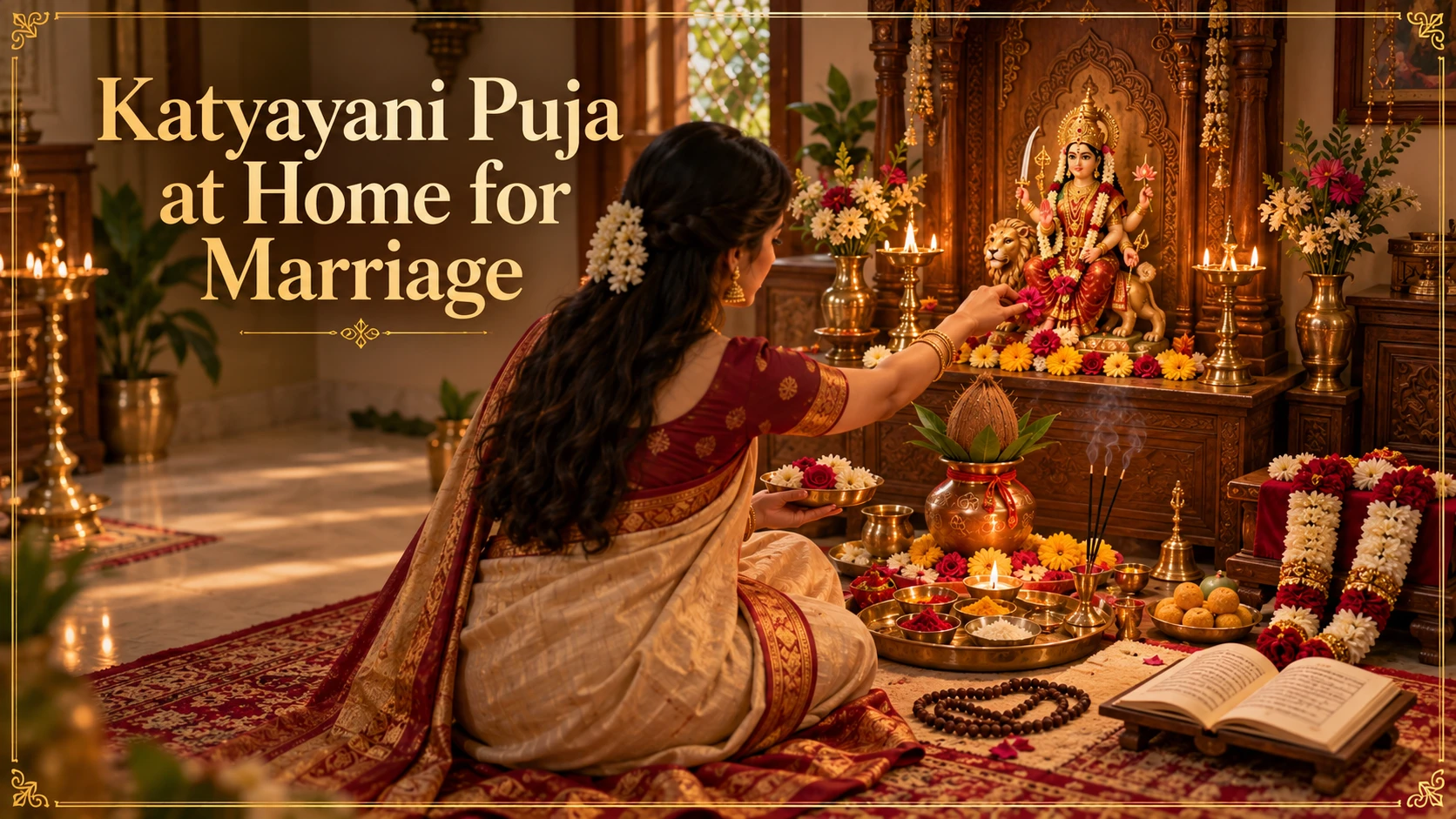
Katyayani Puja at home for marriage is a devotional practice in which devotees worship Maa Katyayani and pray for a suitable, compatible life partner and a harmonious married life. A simple home puja can be performed with a picture or idol of Maa Katyayani, a diya, flowers, basic offerings and mantra chanting.
The sixth form of Navdurga, Maa Katyayani is traditionally worshipped on the sixth day of Navratri. Devotees may also worship her at home outside Navratri according to their family tradition and personal devotional practice.
This guide explains the Katyayani Puja Vidhi at home, required samagri, the marriage mantra, suitable time for worship, and common practices to follow.
Note: Katyayani Puja is a faith-based devotional practice. It should not be presented as a guaranteed way to obtain marriage within a particular period or with a particular person. Practical efforts, communication and thoughtful decisions remain important when seeking a life partner.
Maa Katyayani is a form of Goddess Durga and is traditionally counted as the sixth form of Navdurga. She is worshipped on the sixth day of Navratri.
Traditional representations of Maa Katyayani show her riding a lion and carrying divine weapons. Devotees associate her worship with strength, courage, protection and devotion.
In the context of marriage, Maa Katyayani is traditionally worshipped by devotees who pray for a suitable life partner and seek strength and clarity while navigating marriage-related decisions.
Katyayani worship for marriage is traditionally associated with prayers for a suitable spouse.
A devotee may perform the puja while praying for:
A compatible life partner
Clarity when considering a marriage proposal
Strength and patience during delays in marriage
A respectful and harmonious married life
Wisdom when making relationship decisions
The ability to approach marriage with sincerity and a balanced mind
The intention of the prayer matters. It is more appropriate to pray for a compatible and mutually respectful relationship than to treat the puja as a way to control another person's decision.
A simple home puja does not require an elaborate collection of items. You can prepare the following:
| Puja Samagri | Purpose |
|---|---|
| Maa Katyayani idol or picture | Main object of worship |
| Red or yellow cloth | To prepare the puja space |
| Ghee or oil diya | Traditional lamp offering |
| Incense or dhoop | Fragrant offering |
| Fresh flowers | Offering to Maa Katyayani |
| Kumkum | Traditional puja offering |
| Turmeric | Traditional puja material |
| Akshat (unbroken rice) | Offering during worship |
| Clean water | For offerings and, if used, a kalash |
| Fruits or sweets | Naivedya or bhog |
| Kalash | Optional, depending on the puja procedure |
| Coconut and mango leaves | Optional items for a kalash |
| Mala | For counting mantra repetitions |
If you do not have every item, there is no need to postpone a simple personal prayer. Use clean, suitable materials that are available to you and follow your family tradition where applicable.
A simple Katyayani Puja can be performed in the morning after bathing and wearing clean clothes. Evening worship is also possible if that is the time you can maintain peacefully and consistently.
The sixth day of Navratri has a special traditional association with Maa Katyayani. However, devotees do not necessarily have to wait for Navratri to offer daily prayers to the Goddess.
For a regular home practice, choose a time that allows you to worship without unnecessary distractions.
The following is a simple Katyayani Puja Vidhi at home for marriage. It is intended as a practical devotional routine rather than a substitute for a formal ceremonial procedure prescribed by a priest.
Choose a clean and peaceful place in your home for the worship.
Clean the puja area and place a red or yellow cloth on the platform. Keep the picture or idol of Maa Katyayani on the cloth.
If you follow a particular family or regional tradition for arranging the puja space, follow that practice.
Take a bath and wear clean clothes before beginning the puja.
Sit comfortably in front of Maa Katyayani and keep distractions such as your phone away if possible. The purpose is to give your attention to the prayer rather than rushing through the individual steps.
Light a ghee or oil diya in front of Maa Katyayani.
You may also light incense or dhoop as a traditional offering. Keep the diya on a stable, heat-resistant surface and follow normal fire-safety precautions.
Before making the offerings, calmly express your intention.
You can say a simple prayer such as:
“हे मां कात्यायनी, मुझे योग्य और अनुकूल जीवनसाथी प्राप्त करने, सही निर्णय लेने और विवाह संबंधी परिस्थितियों का धैर्यपूर्वक सामना करने की शक्ति एवं मार्गदर्शन प्रदान करें।”
The exact wording of a personal prayer does not need to be complicated. The intention should be sincere and respectful.
Offer flowers to Maa Katyayani.
You may also offer kumkum and akshat according to your family tradition. If you are using other customary puja materials, offer them respectfully rather than treating the number of items as more important than the worship itself.
After the offerings, chant the traditional Katyayani mantra associated with prayers for marriage:
ॐ कात्यायनि महामाये महायोगिन्यधीश्वरि।
नन्दगोपसुतं देवि पतिं मे कुरु ते नमः॥
Transliteration:
Om Katyayani Mahamaye Mahayoginyadhishwari,
Nandagopa Sutam Devi Patim Me Kuru Te Namah.
The prayer is traditionally understood as an invocation to Maa Katyayani asking for her blessings in relation to marriage.
The wording of this commonly recited marriage mantra is traditionally feminine, particularly in the phrase referring to a husband. Devotees who are not using the mantra in that traditional context can seek guidance on an appropriate prayer or mantra rather than changing Sanskrit words themselves.
For the detailed meaning, pronunciation and chanting method, see our guide to Katyayani Mantra for Marriage.
For Hindi readers, you can also refer to Katyayani Mantra for Marriage in Hindi for the mantra, meaning and chanting method.
There is no need to rush through mantra chanting simply to reach a large number.
For a simple personal practice, a devotee may choose a manageable count such as:
11 repetitions for a short daily prayer
21 repetitions for a longer regular practice
108 repetitions for one complete mala
If your family tradition or priest has prescribed a particular count, follow that guidance instead.
The important point for a personal devotional routine is to choose a practice you can perform calmly and consistently.
Offer fresh fruits, sweets or another appropriate food as bhog or naivedya.
After the puja, the offering can be taken as prasad according to your usual family practice.
You may perform Maa Durga or Maa Katyayani Aarti according to your tradition.
If you do not know a formal aarti, you can simply offer a respectful prayer and ask for wisdom, patience, strength and a compatible life partner.
After completing the worship, sit quietly for a few moments.
You may ask Maa Katyayani for forgiveness for any unintentional mistake in pronunciation or procedure. Conclude the puja respectfully rather than immediately moving on to other activities.
A simple Katyayani Puja does not have to follow one fixed duration for every devotee.
You may choose a routine based on your family tradition, personal faith or guidance from a knowledgeable priest.
For example, a devotee may maintain:
A short daily prayer
Regular mantra chanting
Worship during Navratri
A specific devotional period prescribed by their tradition
If you are specifically following a 21-day Katyayani Puja, keep that procedure separate from this general home-puja guide.
You can read our detailed guide on 21-Day Katyayani Puja Vidhi for Marriage for the day-by-day procedure.
For a simple home practice, keep the following points in mind:
Bathe and wear clean clothes before worship when possible.
Keep the puja area clean.
Chant the mantra clearly and with concentration.
Use fresh and suitable offerings.
Follow your family or regional tradition where applicable.
Keep your intention respectful and sincere.
Do not treat the puja as a method of controlling another person's choices.
Avoid expecting a guaranteed result or a fixed marriage date.
If you are performing a detailed ritual, follow the instructions of a knowledgeable priest.
The rules can vary between traditions, so a practice followed by one family should not automatically be presented as a universal religious rule.
Yes. A simple personal puja involving a picture or idol, diya, flowers, offerings and mantra chanting can be performed at home.
A priest may be appropriate when you want to perform a more elaborate ceremony involving formal ritual procedures, specific sankalp, havan or other practices that require detailed knowledge.
The two forms of worship serve different purposes. Simple home worship can become part of a regular personal devotional routine, while a formal ceremony may require structured guidance.
If you prefer a guided ceremony, you can explore Astrouni's Katyayani Mata Puja for early or desired marriage.
Yes, devotees may worship Maa Katyayani and pray for a suitable life partner.
However, the commonly recited Katyayani marriage mantra is traditionally worded as a prayer from an unmarried woman seeking a husband. Men who wish to perform Katyayani worship for marriage can seek guidance from a knowledgeable priest regarding an appropriate prayer or mantra.
The important distinction is between worshipping Maa Katyayani and using a specific mantra without understanding its traditional wording.
Fasting is not automatically required for a simple home prayer.
Fasting practices can differ according to the devotee's family tradition, religious practice and the type of observance being followed. A person should not undertake restrictive fasting simply because it is presented as compulsory when it is not part of their tradition.
Anyone with a medical condition or dietary restriction should prioritize appropriate medical guidance before fasting.
Katyayani Puja is a devotional practice. It should not be presented as a guaranteed method for getting married within a specific number of days.
A prayer for marriage is better approached as a request for a compatible and respectful relationship rather than an attempt to force a particular person to marry you.
A simple home puja does not become more meaningful merely because more items or steps are added. Follow the procedure you understand and can perform properly.
Mantra chanting is better approached with attention to pronunciation and meaning rather than simply trying to increase the number of repetitions.
Spiritual practice does not replace the practical process of meeting potential partners, discussing expectations, understanding compatibility and making informed relationship decisions.
Both approaches can have a place depending on the devotee's purpose.
| Home Puja | Guided Puja |
|---|---|
| Suitable for personal daily devotion | Suitable for those seeking a formal ceremonial procedure |
| Can be performed with basic puja materials | May involve additional ritual steps |
| Convenient for regular worship | Performed according to a structured procedure |
| Focuses on personal prayer and mantra practice | Provides priestly guidance during the ceremony |
If your goal is to establish a simple personal devotional routine, home worship may be sufficient.
If you want a formal ceremony and are unfamiliar with the required rituals, guidance from a knowledgeable priest can help you follow the appropriate tradition.
Yes. A simple Katyayani Puja can be performed at home with a picture or idol of Maa Katyayani, a diya, flowers, basic offerings and mantra chanting. More elaborate ceremonies may require guidance from a knowledgeable priest.
The sixth day of Navratri is traditionally associated with Maa Katyayani. However, devotees may also worship Maa Katyayani on other days according to their personal practice and family tradition.
For a simple home puja, devotees may offer flowers, kumkum, akshat, fruits or sweets, along with a diya and incense. Follow your family tradition if it specifies particular offerings.
For a personal practice, you may choose a manageable count such as 11, 21 or 108 repetitions. If a particular count has been prescribed by your family tradition or priest, follow that guidance.
Yes, fasting is not automatically necessary for a simple daily puja. Fasting practices vary according to tradition and the type of observance.
Yes. Men can worship Maa Katyayani and pray for a suitable life partner. However, the commonly recited marriage mantra has traditionally feminine wording, so men may seek guidance regarding an appropriate mantra or prayer.
No. A religious or devotional practice should not be presented as a guaranteed way to achieve marriage within a fixed period. Devotees may perform the puja as an expression of faith and as a prayer for guidance, strength and a compatible relationship.
No. Maa Katyayani has a special association with the sixth day of Navratri, but personal worship can also be performed outside Navratri according to the devotee's tradition and practice.
Katyayani Puja at home for marriage can be kept simple: prepare a clean puja space, worship Maa Katyayani, make a sincere prayer, offer flowers and bhog, and chant the traditional mantra with attention and devotion.
There is no need to make the practice unnecessarily complicated or attach a guaranteed timeline to it. If you are following a particular family tradition or undertaking a formal ritual, follow the guidance appropriate to that tradition.
For a specific 21-day Katyayani Puja, refer to our dedicated guide on 21-Day Katyayani Puja Vidhi for Marriage rather than combining the two practices.
Copyright © 2026 Astrouni | All Rights Reserved