
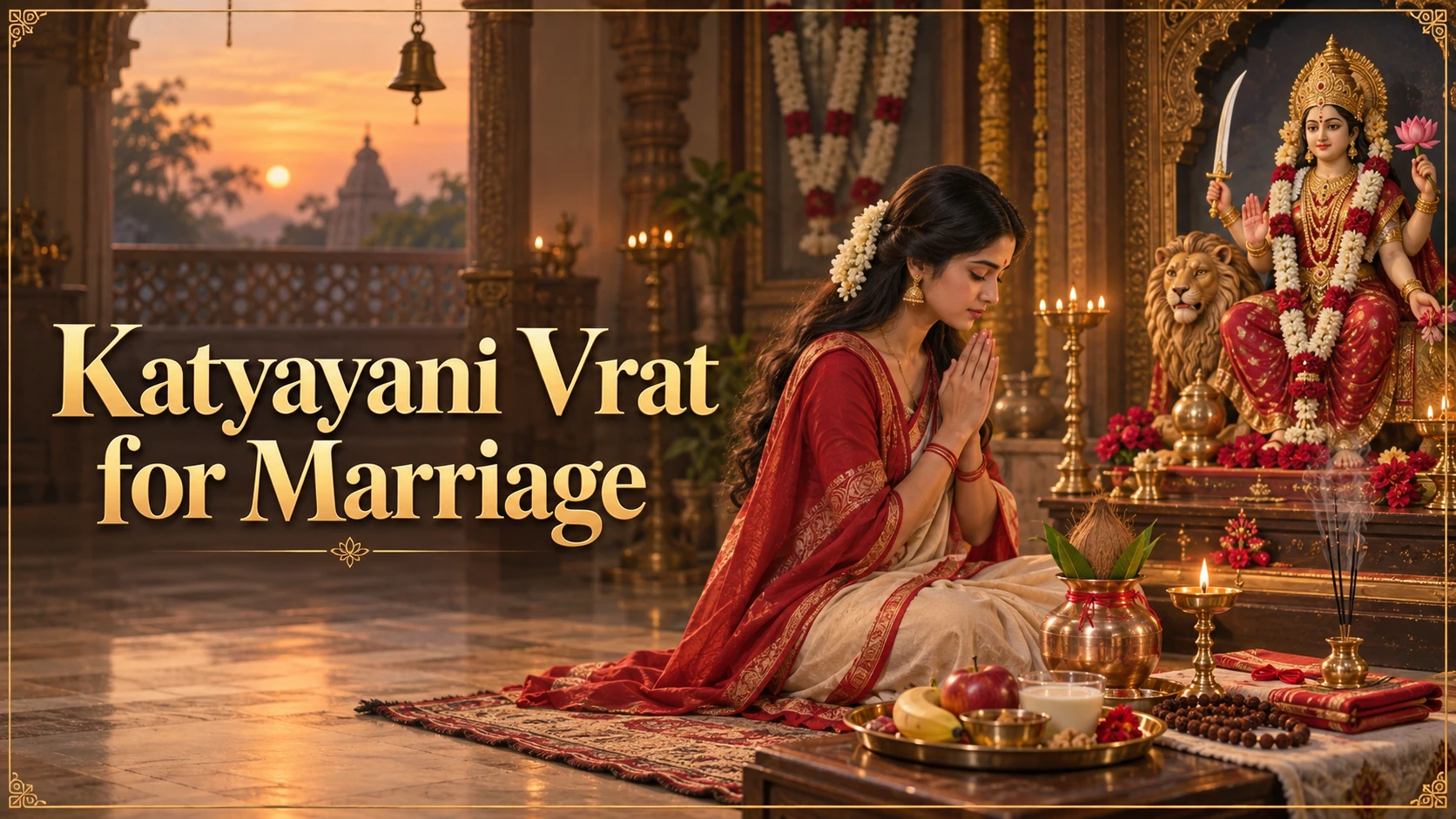
Katyayani Vrat is a traditional devotional practice dedicated to Maa Katyayani, a form of Goddess Durga. Devotees may observe this vrat with prayers for marriage, a suitable life partner, emotional clarity, and spiritual discipline.
For those seeking guidance related to marriage, Katyayani Vrat is often associated with sincere prayer, self-discipline, and devotion. However, the duration, fasting practices, and specific rituals can vary according to family traditions, regional customs, and individual beliefs.
In this guide, you will learn what Katyayani Vrat is, why it is associated with marriage, how to observe it, important rules, fasting practices, the role of the Katyayani mantra, and its traditional spiritual significance.
Katyayani Vrat is a devotional observance dedicated to Maa Katyayani. Devotees follow a period of prayer, worship, discipline, and in some traditions, fasting as an expression of devotion.
Maa Katyayani is one of the forms of Goddess Durga and is traditionally worshipped during different religious observances. The vrat is particularly associated with marriage in certain Hindu traditions.
Katyayani Vrat is not simply about completing a fixed number of days or performing a particular ritual. For many devotees, it is a period of focused devotion, prayer, discipline, and reflection.
The exact method of observing the vrat may differ depending on the tradition being followed.
Maa Katyayani has a special association with marriage in Hindu devotional tradition.
The connection is especially known from the Bhagavata Purana, which describes the young unmarried girls of Vraja worshipping Goddess Katyayani with the desire to have Krishna as their husband.
Because of this traditional association, devotees may worship Maa Katyayani while praying for a suitable life partner or desired marriage.
The practice should be understood as a form of devotional prayer rather than a guaranteed method for achieving a particular marriage outcome.
Devotees who observe Katyayani Vrat for marriage may include prayers for:
A suitable and compatible life partner
Clarity when considering marriage proposals
Patience during delays or uncertainty
Positive intentions toward marriage
Emotional strength and self-discipline
Harmony and mutual understanding in future married life
The spiritual purpose of the vrat can also extend beyond marriage. Regular worship may provide devotees with a structured period for prayer, reflection, and connection with their faith.
The exact Katyayani Vrat Vidhi may vary according to family and regional traditions. A simple devotional approach can include the following steps.
Before starting the vrat, devotees may take a personal sankalp, or devotional intention.
The sankalp can be expressed in simple words, such as a sincere prayer to Maa Katyayani for guidance, a suitable life partner, and a peaceful married life.
The intention should be personal and respectful rather than focused only on a specific outcome.
Clean the area where you plan to perform the worship.
You can place a clean cloth and arrange an image or idol of Maa Katyayani in the puja space.
Devotees traditionally begin worship after bathing and wearing clean clothes.
The purpose is to begin the devotional practice with cleanliness and a focused state of mind.
Light a diya before Maa Katyayani.
You may also offer incense if it is part of your regular worship tradition.
Offer flowers and other suitable devotional offerings to Maa Katyayani.
The exact offerings can vary according to your family tradition or the puja method you follow.
Sit peacefully before the deity and offer your prayer.
You can pray for a suitable life partner, clarity in marriage decisions, family harmony, and spiritual strength.
Devotees may include the traditional Katyayani mantra in their worship.
One commonly recited mantra is:
ॐ कात्यायनि महामाये महायोगिन्यधीश्वरि।
नन्दगोपसुतं देवि पतिं मे कुरु ते नमः॥
A simple transliteration is:
Om Katyayani Mahamaye Mahayoginy Adhishwari
Nanda Gopa Sutam Devi Patim Me Kuru Te Namah
The number of repetitions may differ according to the practice being followed. Some devotees choose a fixed count as part of their daily discipline.
For detailed information about the mantra, its meaning, and chanting method, you can read our dedicated guide on Katyayani Mantra for Marriage.
After chanting, sit quietly for a few moments and complete your prayer.
You may offer a simple personal prayer to Maa Katyayani and conclude the worship according to your family tradition.
There is no single universal set of rules followed by every devotee. Practices can differ based on family tradition, regional customs, and personal circumstances.
However, devotees commonly focus on the following principles:
Keep yourself and the puja space clean during the period of worship.
Some devotees prefer simple, vegetarian, and sattvic food while observing the vrat.
Try to maintain discipline in your daily routine and avoid activities that go against your devotional intention.
The purpose of a vrat is not only external ritual. Devotees may also use the period for prayer, reflection, and maintaining a peaceful state of mind.
A devotional practice should not be treated as a guaranteed way to control another person's decisions or circumstances.
If you are following a specific family, temple, or spiritual tradition, follow the instructions associated with that tradition rather than combining unrelated practices.
Fasting practices can vary.
Some devotees observe a complete fast, while others follow a partial fast or consume simple food during the vrat. Certain traditions may also prescribe specific foods or restrictions.
Fasting should therefore be understood within the context of the particular tradition being followed.
If fasting causes weakness or is unsuitable because of your personal circumstances, it is better to seek appropriate guidance rather than treating fasting as the only measure of devotion.
The central focus of the vrat is sincere worship, discipline, and prayer.
The duration of Katyayani Vrat is not necessarily identical across all traditions.
Some devotional practices may be observed for a specific number of days, while others are connected with particular religious periods or observances.
A 21-day Katyayani practice is also followed by some devotees, but 21 days should not automatically be presented as a universal requirement for every form of Katyayani Vrat.
If you are following a particular vrat tradition, use the duration prescribed by that tradition.
You can also learn more about a 21-day devotional practice in our guide to 21-Day Katyayani Puja Vidhi for Marriage.
Katyayani Vrat and Katyayani Mantra are related but they are not the same practice.
Katyayani Vrat generally refers to a devotional observance that may involve worship, discipline, prayer, fasting, and specific rules.
Katyayani Mantra refers specifically to the sacred verse or mantra recited during worship.
A devotee may include mantra chanting as one part of a Katyayani Vrat.
Therefore, someone searching for the mantra may need different guidance from someone looking for the complete vrat procedure.
Devotional practices can vary by tradition, and observance should be understood according to the specific vrat tradition being followed.
The association of Katyayani worship with marriage is especially well known through the traditional account of the unmarried girls of Vraja. However, this does not mean that every form of Katyayani worship has identical eligibility rules.
If a particular family or temple tradition gives specific instructions regarding who can observe a particular vrat, those instructions should be followed.
Food rules depend on the type of vrat being observed.
Depending on the tradition, devotees may choose:
Fruits
Milk or dairy products
Simple vegetarian food
Vrat-appropriate foods
Water, depending on the fasting method
Some devotees may observe a stricter fast.
There is no need to assume that one food practice applies universally to every Katyayani Vrat. Follow the dietary rules of the specific tradition you have chosen.
If you are following a multi-day devotional practice and miss a day, do not assume that the entire practice has automatically become meaningless.
Different traditions may have different instructions regarding missed days.
You can resume your worship and, if you are following guidance from a priest, guru, temple, or family tradition, ask them how the observance should be continued.
The intention behind the practice is also an important part of devotional observance.
The traditional significance of Katyayani Vrat comes from the devotional association between Goddess Katyayani and the desire for a suitable husband.
The Bhagavata Purana describes the unmarried girls of Vraja worshipping Goddess Katyayani during their observance and praying to have Krishna as their husband.
This story is an important reason why Katyayani worship became associated with marriage-related prayers in Hindu devotional traditions.
For modern devotees, the vrat can also become a period of focused prayer, discipline, and personal reflection.
Devotees may consider the following among the spiritual values of observing a vrat:
Following a regular worship routine can create dedicated time for prayer and spiritual practice.
Maintaining a devotional routine can encourage consistency and personal discipline.
A period of prayer can provide an opportunity to reflect on personal expectations, relationships, and life decisions.
Marriage-related uncertainty can sometimes involve waiting and emotional pressure. A structured devotional practice may help devotees maintain patience and focus on their spiritual routine.
For people who follow Hindu devotional traditions, worshipping Maa Katyayani can be a meaningful way to strengthen their connection with their faith.
These are spiritual and devotional benefits, not scientifically established outcomes.
Katyayani Vrat should not be presented as a guaranteed method for marriage.
A person's marriage can depend on many personal, social, family, and practical circumstances. A devotional practice cannot guarantee a specific person, marriage date, or relationship outcome.
For devotees, the value of the vrat may instead lie in sincere prayer, discipline, faith, and reflection.
If you are facing uncertainty about marriage, devotional practices can be part of your spiritual routine while practical decision-making and communication remain important.
Although the terms are sometimes used together, vrat and puja refer to different aspects of devotional practice.
A vrat generally emphasizes an observance or discipline maintained for a particular period.
A puja refers to the worship ritual performed for the deity.
A Katyayani Vrat may therefore include Katyayani Puja as part of the overall observance.
If you want a detailed guide specifically about performing the puja at home, see our article on How to Perform Katyayani Puja at Home for Marriage.
If your chosen tradition permits a simple daily practice, you can maintain a routine such as:
Wake up and complete your morning routine.
Bathe and wear clean clothes.
Clean your puja space.
Light a diya before Maa Katyayani.
Offer flowers and other traditional offerings.
Take your devotional sankalp.
Chant the Katyayani mantra according to your chosen practice.
Offer your personal prayer.
Spend a few quiet moments in reflection.
Follow your chosen dietary and vrat rules throughout the day.
The exact routine should be adjusted according to the tradition you are following.
While observing the vrat, devotees can keep a few points in mind:
Do not treat the vrat as a guaranteed shortcut to marriage.
Do not assume that every devotee must follow exactly the same fasting rules.
Do not mix different vrat traditions without understanding their requirements.
Do not focus only on the number of mantra repetitions while ignoring the devotional purpose.
Do not make promises or expectations about another person's choices through a religious practice.
Do not ignore personal circumstances when following strict fasting practices.
A sincere and consistent practice is generally more meaningful than simply completing rituals mechanically.
Katyayani Vrat for marriage is a devotional observance dedicated to Maa Katyayani, traditionally associated with prayers for a suitable husband or marriage. Devotees may observe it with worship, prayer, discipline, and sometimes fasting.
The procedure can vary by tradition. A simple observance may include bathing, cleaning the puja space, worshipping Maa Katyayani, offering flowers, chanting the Katyayani mantra, praying, and following the dietary or behavioral rules associated with the chosen vrat.
The traditional association with marriage comes from the account of the unmarried girls of Vraja worshipping Goddess Katyayani. However, specific observance rules can vary by tradition, so eligibility should be understood according to the particular vrat being followed.
Not necessarily. Fasting practices vary between traditions. Some devotees observe a complete fast, while others follow partial fasting or eat simple vrat-appropriate food.
There is no single duration that applies universally to every Katyayani Vrat tradition. Some practices are observed for a prescribed religious period, while some devotees follow specific multi-day devotional practices.
Devotees may observe Katyayani Vrat as a form of prayer during periods of marriage-related uncertainty or delay. However, it should not be presented as a guaranteed solution or as a way to predict when marriage will happen.
One commonly recited mantra is:
ॐ कात्यायनि महामाये महायोगिन्यधीश्वरि।
नन्दगोपसुतं देवि पतिं मे कुरु ते नमः॥
The appropriate method and repetition count can vary according to the devotional tradition being followed.
Yes, devotees may perform a simple form of Katyayani worship at home according to their tradition. Those following a specific vrat procedure should follow the instructions associated with that tradition.
Its marriage-related significance comes from the traditional story of the unmarried girls of Vraja worshipping Goddess Katyayani with the desire to have Krishna as their husband. For devotees today, the practice may also represent focused prayer, discipline, faith, and reflection.
Katyayani Vrat is a traditional devotional practice associated with Maa Katyayani and, in particular, prayers related to marriage. Its observance can involve worship, mantra chanting, fasting, personal discipline, and sincere prayer.
The exact rules and duration can differ between traditions, so it is important not to treat one specific procedure as the only valid method of observing the vrat.
For devotees, the deeper purpose can be to approach Maa Katyayani with faith, maintain devotional discipline, and use the period for sincere prayer and reflection.
If you are looking for a detailed mantra practice, read our guide to Katyayani Mantra for Marriage. For home worship, see How to Perform Katyayani Puja at Home for Marriage. If you want to understand a specific 21-day practice, explore our 21-Day Katyayani Puja Vidhi for Marriage guide.
Copyright © 2026 Astrouni | All Rights Reserved