
No Blog Found
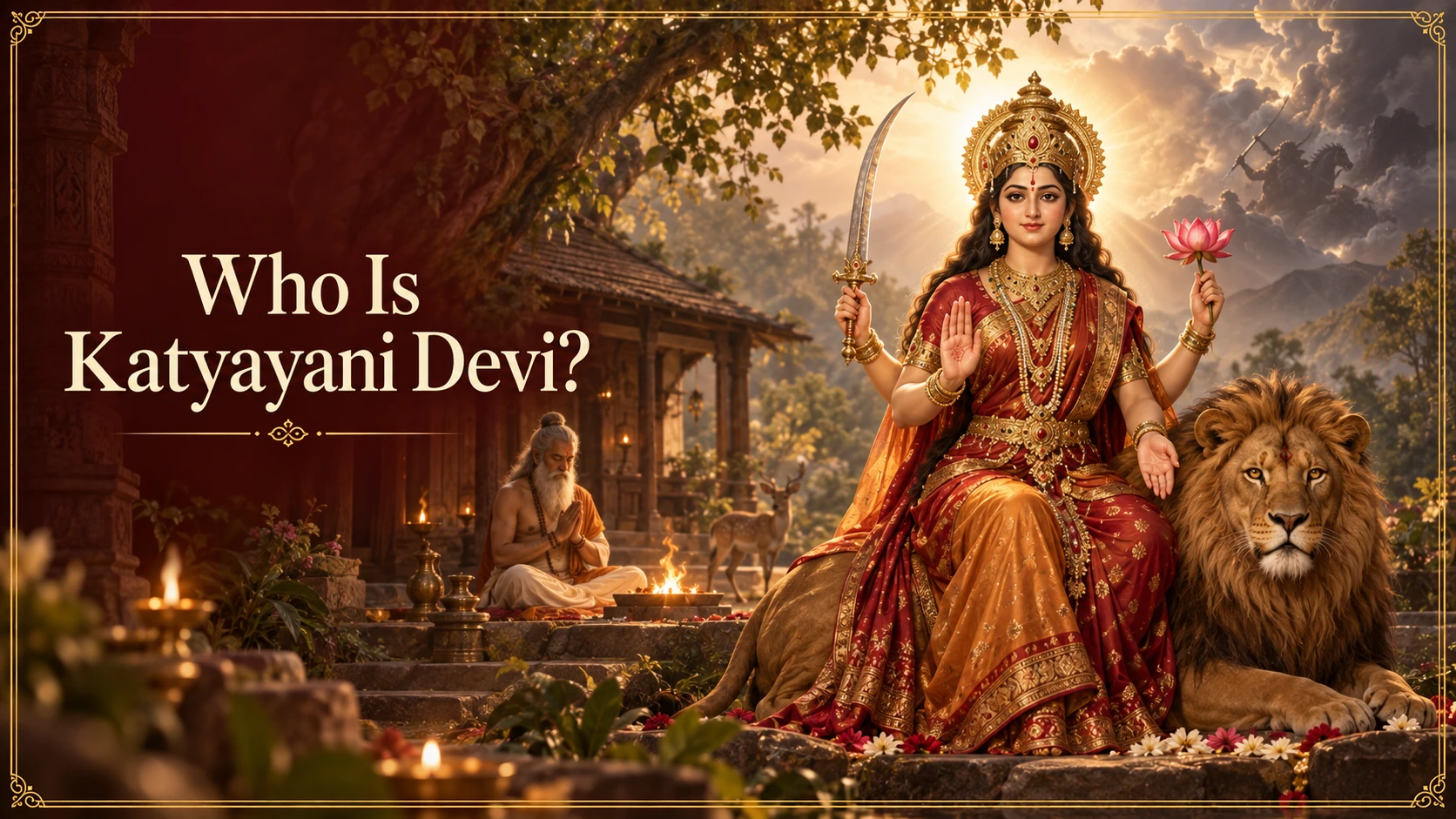
Maa Katyayani is the sixth form of Navdurga and a powerful manifestation of Goddess Durga. She represents courage, protection, righteous action and the strength required to confront fear and injustice. Devotees worship Katyayani Devi on the sixth day of Navratri and traditionally seek her blessings for spiritual strength, clarity and a suitable life partner.
The story of Maa Katyayani connects several important Hindu traditions. She is associated with Sage Katyayana, the divine battle against Mahishasura and the worship performed by the unmarried girls of Vraja, who prayed to have Shri Krishna as their husband.
This guide explains who Katyayani Devi is, the meaning and origin of her name, her traditional story, appearance, symbols, Navratri significance and connection with marriage.
Katyayani Devi is worshipped as the sixth form among the nine manifestations of Goddess Durga collectively known as Navdurga. She expresses the warrior and protective aspect of the Divine Mother.
In Hindu devotional tradition, Maa Katyayani is regarded as a courageous form of Shakti who confronts destructive forces and helps restore dharma. Her strength is not uncontrolled aggression; it is disciplined divine power used to protect, correct imbalance and overcome injustice.
Although Maa Katyayani is widely associated with marriage-related prayers, her spiritual meaning is much broader. She also represents:
Courage during difficult circumstances
Protection from harmful influences
Clarity before important decisions
Strength combined with compassion
Self-discipline and determination
Victory over fear and destructive tendencies
Responsible action guided by dharma
The sixth day of Navratri, known as Shashthi, is traditionally dedicated to her worship.
The name “Katyayani” is traditionally connected with Sage Katyayana.
According to widely followed Puranic traditions, Sage Katyayana performed deep penance and prayed to the Divine Mother. The Goddess manifested in connection with his devotion and became known as Katyayani.
The name is commonly understood as:
The Goddess associated with Sage Katyayana
The divine daughter connected with Katyayana
The warrior manifestation of Goddess Durga
A form of Shakti invoked for courage and protection
The precise details vary across texts and regional traditions. Therefore, one modern retelling should not be treated as the only version of her origin. However, the relationship between the name Katyayani and Sage Katyayana remains central to her traditional identity.
Puranic traditions describe a time when the powerful asura Mahishasura created disorder and became difficult for the gods to defeat. Divine energies united, giving rise to a radiant and powerful manifestation of the Goddess.
Different traditions describe this divine manifestation with varying details. Maa Katyayani is widely identified with the warrior aspect of the Divine Mother who confronts Mahishasura.
One popular account connects her manifestation with the hermitage and devotion of Sage Katyayana. The sage worshipped the Goddess, and she became known as Katyayani because of her association with him.
Her origin communicates an important spiritual principle: when arrogance, injustice and destructive power create imbalance, divine Shakti manifests to restore harmony.
Maa Katyayani therefore represents power guided by responsibility. Her strength protects dharma rather than serving personal pride.
Mahishasura is traditionally described as a powerful asura capable of assuming different forms, including that of a buffalo. His changing forms can symbolically represent negative tendencies that repeatedly return in different ways.
Pride may become anger. Fear may become aggression. Attachment may turn into anxiety, while confusion can prevent a person from taking responsible action.
The Divine Mother fought Mahishasura and defeated him. Her victorious form is widely called Mahishasuramardini, meaning “the slayer of Mahishasura.” Devotional traditions frequently connect Maa Katyayani with this powerful warrior manifestation.
The story can be understood as both a sacred narrative and a spiritual symbol of overcoming:
Ego and arrogance
Fear and self-doubt
Anger without direction
Harmful attachments
Injustice and misuse of power
Confusion that obstructs right action
Maa Katyayani’s victory teaches that strength becomes meaningful when it is used to protect what is right.
Navdurga refers to the nine forms of Goddess Durga worshipped during the nine days of Navratri. Each form represents a particular divine quality and stage of spiritual development.
Maa Katyayani is worshipped as the sixth Navdurga. At this stage of the Navratri journey, the devotee is encouraged to develop courage, determination and readiness to face inner and external difficulties.
She is traditionally associated with:
Fearlessness
Protection
Determination
Righteous action
Victory over negativity
Strength guided by wisdom
Clarity in challenging situations
Her place as the sixth Navdurga symbolises a movement from preparation and spiritual discipline toward courageous action.
Maa Katyayani is commonly portrayed as a radiant warrior Goddess seated on or accompanied by a lion. In a widely recognised form, she has four arms:
One hand carries a sword
One hand holds a lotus
One hand displays Abhaya Mudra
One hand displays Varada Mudra
Her exact appearance can vary according to temple traditions, regions and artistic representations.
| Symbol | Traditional meaning |
|---|---|
|
Courage, discernment and removal of ignorance |
|
Purity and spiritual development |
|
Fearlessness and divine protection |
|
Compassion, blessings and generosity |
|
Courage, authority and disciplined strength |
The sword represents the power to cut through ignorance, fear and confusion. Spiritually, it signifies discernment—the ability to recognise what is right and act responsibly.
The lotus grows in muddy water while remaining clean. It represents purity, integrity and the possibility of spiritual growth even when circumstances are difficult.
Abhaya Mudra is the gesture of fearlessness and protection. It reassures devotees and encourages them to face challenges with faith and courage.
Varada Mudra represents compassion, generosity and the granting of blessings. It shows that Maa Katyayani’s warrior strength exists alongside her nurturing nature.
The lion symbolises courage, command and powerful energy brought under spiritual discipline. It teaches that strength should be guided by wisdom rather than impulse.
The story of Maa Katyayani is not limited to an external battle. It can also represent the inner struggle against fear, confusion, ego and destructive habits.
Her symbolism encourages devotees to cultivate:
Courage without cruelty
Confidence without arrogance
Discipline without rigidity
Strength combined with compassion
Patience during uncertainty
Clear thinking in emotional situations
Commitment to truth and responsible action
Her worship can become a period of reflection. A devotee may ask:
Which fear is preventing me from acting responsibly?
Am I making decisions through clarity or impulse?
Where do I need greater discipline?
Is my strength being used constructively?
Which habits repeatedly disturb my peace?
How can courage and compassion work together?
These questions make her symbolism relevant beyond ritual worship.
One of the best-known scriptural connections between Maa Katyayani and marriage appears in the Shrimad Bhagavatam.
The text describes the unmarried girls of Vraja observing a devotional practice and worshipping Goddess Katyayani. They prayed for Nanda’s son, Shri Krishna, to become their husband.
Their traditional prayer includes the well-known verse:
ॐ कात्यायनि महामाये महायोगिन्यधीश्वरि।
नन्दगोपसुतं देवि पतिं मे कुरु ते नमः॥
Transliteration:
Om Katyayani Mahamaye Mahayoginy Adhishwari,
Nanda Gopa Sutam Devi Patim Me Kuru Te Namah.
The episode created an enduring association between Maa Katyayani and prayers for a desired or suitable husband.
However, the story should be understood within its devotional and scriptural context. It represents sincere spiritual intention and wholehearted devotion—not a guaranteed technique for controlling another person or obtaining a particular relationship.
For the mantra’s complete meaning, pronunciation and chanting guidance, read Katyayani Mantra for Marriage: Meaning, Benefits and Chanting Method.
Maa Katyayani’s association with marriage arises primarily from the worship performed by the unmarried girls of Vraja. Over time, devotees began seeking her blessings for guidance related to marriage.
People may worship Maa Katyayani while praying for:
A suitable and compatible life partner
Clarity while considering marriage proposals
Patience during marriage-related delays
Emotional strength during uncertainty
Wisdom in relationship decisions
Mutual respect and harmony in married life
Devotional worship should not be presented as a guarantee of marriage, a particular person or a fixed marriage date. Marriage also depends on compatibility, communication, personal choices, family circumstances and practical decision-making.
Readers interested in fasting and observance rules can read Katyayani Vrat for Marriage: Vidhi, Rules, Benefits and Significance.
The sixth day of Navratri is dedicated to Maa Katyayani. Devotees worship her with prayer, a diya, flowers, mantra recitation and offerings followed in their family or regional tradition.
Her worship on Navratri Day 6 focuses on:
Developing courage
Purifying intention
Seeking protection
Overcoming inner negativity
Strengthening self-discipline
Acting according to dharma
Practices may differ between regions and families. Some devotees observe fasting, while others follow a simple sattvic lifestyle and regular worship.
The central purpose is sincere devotion rather than mechanically copying every practice found online.
A simple form of devotional worship may include:
Bathe and wear clean clothes.
Clean the puja area.
Place an image or idol of Maa Katyayani.
Light a diya and incense.
Offer flowers, fruit or other traditional offerings.
Recite prayers or the Katyayani mantra.
Sit quietly and offer a sincere personal prayer.
Conclude with aarti according to your tradition.
The complete puja procedure has not been repeated here because it belongs to a different search intent. Readers who need detailed instructions can follow the dedicated 21-Day Katyayani Puja Vidhi for Marriage.
Specific family, temple or guru traditions should be respected instead of combining unrelated practices.
These terms are related but describe different aspects of the Divine Mother.
| Term | Meaning |
|---|---|
|
The Divine Mother and protective Shakti worshipped in numerous forms |
|
The collective group of nine Durga forms worshipped during Navratri |
|
The sixth Navdurga, associated with courage and righteous. action |
Maa Katyayani is not separate from Durga in the sense of being an unrelated deity. She is worshipped as a particular manifestation of the same divine Shakti.
Some challenges cannot be solved through avoidance. Maa Katyayani inspires calm, disciplined and responsible action.
Strength without wisdom can become destructive. Her story teaches that power should protect dharma and restore balance.
Her marriage association can remind devotees to approach relationships with sincerity, compatibility, respect and sound judgment.
Although she is a warrior Goddess, her blessing gestures represent protection and generosity. Courage and compassion do not need to oppose each other.
Prayer and disciplined practice can provide emotional steadiness when personal circumstances remain uncertain.
Marriage is an important part of her devotional tradition, but it is not her only significance. She also represents courage, protection, spiritual discipline and victory over destructive tendencies.
Her marriage-related tradition is especially associated with unmarried girls, but Maa Katyayani is a form of Goddess Durga worshipped more broadly. Specific vrat rules may vary according to tradition.
No devotional practice can responsibly guarantee a particular person, marriage date or outcome. Worship should be approached as an expression of faith and spiritual intention.
A vrat is an observance that may include fasting, behavioural discipline and worship over a specific period. Puja refers to the worship ritual itself. A Katyayani Vrat may include Katyayani Puja, but the two terms are not identical.
Regional, family and temple traditions can differ. One modern online routine should not automatically be treated as the only universally correct method.
Katyayani Devi is the sixth form of Navdurga and a warrior manifestation of Goddess Durga. She represents courage, protection, disciplined strength and victory over destructive forces.
Her name is traditionally connected with Sage Katyayana. Puranic traditions associate her manifestation with the sage’s devotion and worship.
Maa Katyayani is traditionally worshipped on the sixth day of Navratri, known as Shashthi.
Katyayani is a particular manifestation of Goddess Durga and the sixth form among Navdurga.
The Shrimad Bhagavatam describes the unmarried girls of Vraja worshipping Goddess Katyayani and praying for Shri Krishna to become their husband. This established her traditional association with marriage-related prayers.
She represents courage, protection, discernment, righteous action, disciplined power and the restoration of dharma.
She is commonly shown seated on or accompanied by a lion, which symbolises fearlessness, authority and controlled strength.
In a widely recognised four-armed representation, she holds a sword and lotus while displaying Abhaya Mudra and Varada Mudra. Her iconography may vary between traditions.
As a form of Goddess Durga, Maa Katyayani may be worshipped by devotees generally. Particular vrat traditions can have their own observance rules.
Navratri Day 6 is especially dedicated to her, but devotees may offer regular prayers according to their family or spiritual tradition.
Maa Katyayani is the sixth form of Navdurga and a powerful expression of courageous, protective and compassionate Shakti. Her association with Sage Katyayana, the divine victory over Mahishasura and the prayers of the unmarried girls of Vraja gives her story several layers of religious and spiritual meaning.
Although she is widely worshipped for marriage-related blessings, her significance extends far beyond marriage. She teaches devotees to confront fear, use strength responsibly, maintain clarity and remain committed to dharma.
Those seeking structured, priest-guided worship may explore Katyayani Mata Puja for Early or Desired Marriage.
Devotional worship should be approached with sincerity and respect while recognising that personal and marriage outcomes also depend on responsible choices and practical circumstances.
Shrimad Bhagavatam, Canto 10, Chapter 22
Devi Mahatmya, traditionally included in the Markandeya Purana
Puranic traditions concerning Sage Katyayana and the warrior manifestation of the Divine Mother
Copyright © 2026 Astrouni | All Rights Reserved