
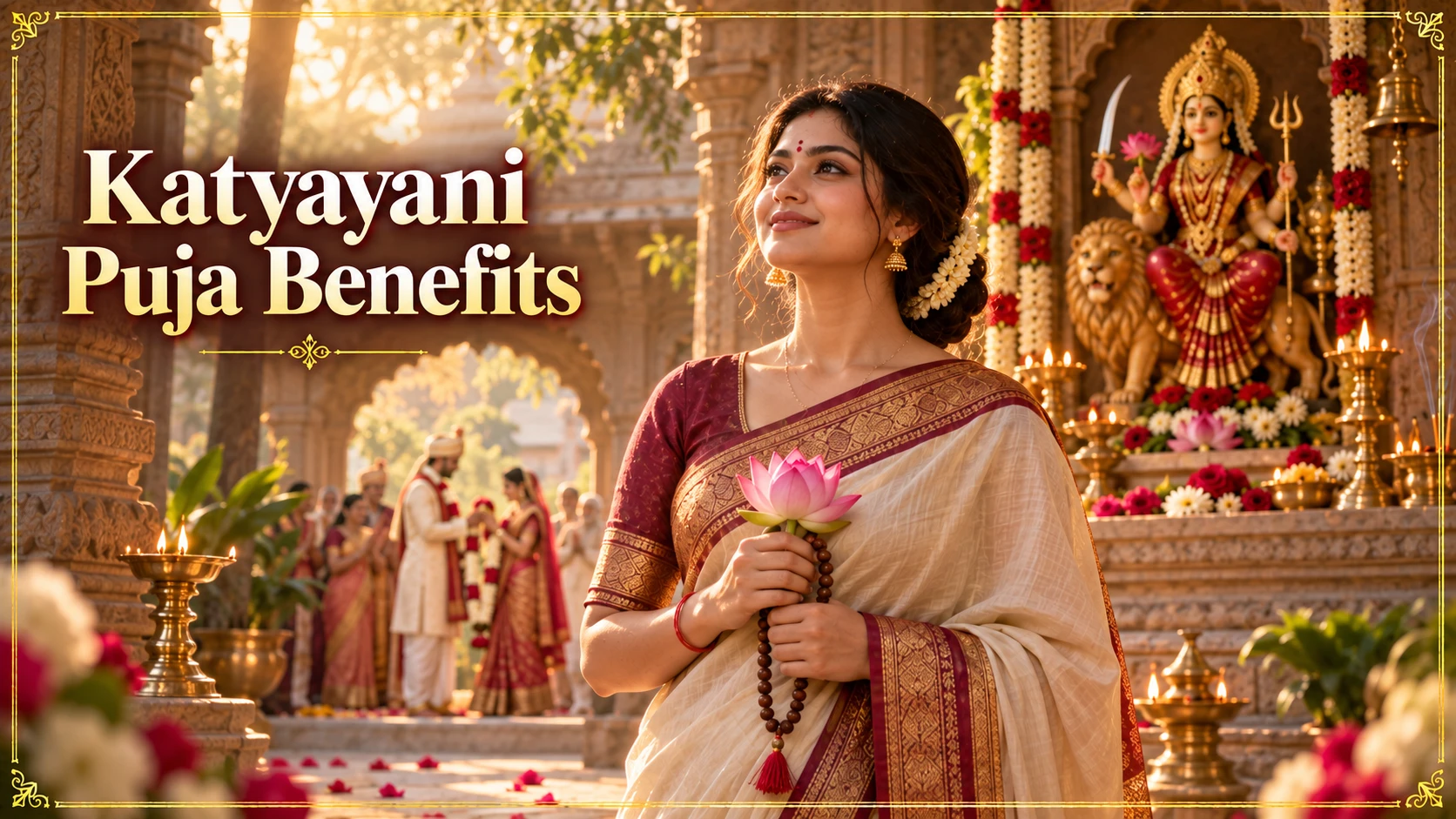
Maa Katyayani is the sixth form of Navdurga and represents divine courage, determination and protection. Devotees traditionally worship her to seek strength during difficult circumstances, clarity in important decisions and blessings for a suitable marriage.
Among unmarried devotees, Maa Katyayani is especially associated with prayers for finding a compatible life partner and facing marriage-related delays with patience. However, the benefits of Katyayani Puja are not limited to marriage. Regular worship can also support spiritual discipline, emotional stability, self-reflection and a more positive approach towards relationships.
This guide explains the traditional Katyayani Puja benefits for marriage, its spiritual significance, who may perform the puja and the responsible way to approach this devotional practice.
Important: Katyayani Puja is a faith-based spiritual practice. It should not be promoted as a guaranteed remedy for marriage, relationship success, medical concerns or mental-health conditions.
Maa Katyayani is worshipped as one of the nine forms of Goddess Durga. She is traditionally honoured on the sixth day of Navratri and is depicted as a powerful divine form associated with courage, protection and the victory of righteousness over negativity.
Devotees worship Maa Katyayani to seek the inner strength required to overcome fear, uncertainty and emotional confusion. In marriage-related worship, devotees pray for wisdom, compatibility and a relationship based on mutual respect.
In Sanatan tradition, Maa Katyayani is closely associated with prayers for a suitable life partner. Unmarried devotees may worship her when they are experiencing delays in marriage, repeated unsuccessful proposals or uncertainty about an important relationship decision.
The purpose of the worship should be to seek divine guidance—not to control the thoughts, feelings or decisions of a particular person.
A respectful prayer may ask Maa Katyayani for:
One of the most widely recognised Katyayani Puja benefits for marriage is the opportunity to pray for a compatible and responsible life partner.
Compatibility involves values, communication, emotional maturity, mutual respect and long-term understanding. Therefore, the prayer should focus on receiving the right guidance rather than simply getting married quickly.
A delay in marriage can create worry, frustration and social pressure. Regular worship can provide a structured spiritual routine through which devotees express their concerns and seek strength.
The puja does not guarantee that every marriage-related delay will immediately disappear. Its spiritual purpose is to help the devotee maintain patience, hope and clarity while continuing appropriate practical efforts.
Marriage decisions should not be made only because of social pressure or fear of delay. Katyayani Puja may provide a calm devotional environment in which a person can reflect on an important proposal.
Devotees may pray for the wisdom to recognise:
The final decision should still be based on communication, consent and careful evaluation.
Sometimes a person becomes emotionally attached to a relationship that lacks mutual respect, commitment or compatibility. Devotional practice can encourage honest self-reflection.
A sincere prayer to Maa Katyayani may focus on receiving the courage to accept reality, respect another person’s decision and move away from an unhealthy relationship.
Spiritual worship should never be used to force a specific person into marriage.
Repeated disappointment can create fear or negativity about marriage. A consistent puja routine may help devotees replace constant worry with prayer, patience and constructive action.
This does not mean ignoring genuine concerns. A positive approach involves remaining hopeful while evaluating every proposal responsibly.
Although Maa Katyayani is commonly worshipped by unmarried devotees, married couples may also offer respectful prayers for mutual understanding, patience and harmony.
Serious marital problems involving abuse, manipulation, violence or mental-health concerns require appropriate professional or legal support. Puja should never replace necessary real-world intervention.
Performing puja regularly requires time, cleanliness and concentration. Following a consistent routine can help develop discipline in spiritual life.
The devotee learns to create time for prayer even while managing professional, personal and family responsibilities.
Mantra chanting and focused prayer encourage the devotee to remain present during the puja. Over time, this may make the worship experience more attentive and meaningful.
The goal should not be to complete a large number of repetitions hurriedly. Calm and clear chanting is more valuable than mechanical repetition.
Prayer can offer a peaceful space for processing uncertainty and expressing personal concerns. Some devotees may experience a greater sense of calm after regular worship.
However, puja should not be presented as medical treatment. Anyone experiencing persistent anxiety, depression or serious emotional distress should seek qualified mental-health support.
Maa Katyayani represents courage and divine strength. Worshippers may use the puja as an opportunity to reflect on the qualities they need in their own lives.
These qualities may include:
A consistent spiritual practice may help devotees redirect their attention from repetitive fear towards prayer and constructive action.
This benefit should be understood as spiritual support rather than a promise that every negative thought or difficult circumstance will automatically disappear.
Marriage-related puja should not focus only on what a devotee expects from a future partner. It can also become an opportunity for self-improvement.
A devotee may reflect on questions such as:
Katyayani Puja and mantra chanting are connected, but they are not exactly the same practice.
| Katyayani Puja | Katyayani mantra chanting |
|---|---|
| Includes diya, flowers, offerings and prayer | Focuses mainly on mantra repetition |
| May involve sankalp, bhog and aarti | Can be included in a short daily routine |
| Creates a complete worship experience | Supports concentration and devotional discipline |
| Can be performed personally or with guidance | Can generally be practised individually |
| May include a formal ritual procedure | Requires clear and respectful chanting |
For the mantra’s Sanskrit text, meaning and chanting rules, read our complete guide to the Katyayani Mantra for Marriage.
For the same information in Hindi, visit Katyayani Mantra for Marriage in Hindi.
Katyayani Puja may be performed by devotees who are:
Men may also worship Maa Katyayani. However, the commonly recited marriage mantra has traditionally feminine wording. Male devotees may use an appropriate personal prayer or seek guidance regarding a suitable mantra.
A devotee can perform a simple daily worship by:
For complete materials and detailed instructions, follow our guide on how to perform Katyayani Puja at home for marriage.
Some devotees choose to maintain Katyayani worship for 21 days as a disciplined devotional routine. This duration is not a guaranteed formula or compulsory rule for everyone.
Anyone following a 21-day practice should select a manageable mantra count and avoid making an unrealistic sankalp.
For the complete daily schedule, sankalp and final-day procedure, read our 21-Day Katyayani Puja Vidhi for Marriage.
To approach Katyayani Puja responsibly:
It is important to maintain honest expectations. Katyayani Puja cannot responsibly be claimed to guarantee:
The puja should be presented as a devotional practice through which worshippers seek blessings, courage and clarity.
A simple personal prayer can be performed at home. Devotees seeking a formal sankalp, complete ritual procedure or priestly guidance may consider a professionally conducted puja.
| Home worship | Guided puja |
|---|---|
|
→ Suitable for a formal ritual |
|
→ May include detailed sankalp and offerings |
|
→ Conducted with priestly guidance |
|
→ Follows a structured ritual process |
For a guided ceremony, explore Astrouni’s Katyayani Mata Puja for early or desired marriage.
Traditionally associated benefits include prayer for a suitable marriage, emotional strength, spiritual discipline, clarity in relationship decisions and courage during uncertain circumstances.
Devotees traditionally perform the puja when facing marriage-related obstacles. However, it should not be promoted as a guaranteed method for removing every delay.
A devotee may pray for guidance and a harmonious relationship, but the practice should never be used to control another person or override consent.
Yes. Married devotees may worship Maa Katyayani for courage, spiritual strength and harmony. The prayer can be adjusted according to the devotee’s circumstances.
A devotee may chant 11, 21 or 108 times according to personal capacity and guidance. Consistency and clarity are more important than hurried repetition.
Fasting is not automatically compulsory for simple daily worship. Practices differ according to family tradition, health and the type of sankalp.
No. Spiritual worship should not be presented as a way to control someone’s feelings or decisions. Prayers should focus on a compatible relationship based on mutual consent.
The traditional Katyayani Puja benefits extend beyond prayers for marriage. Worship can help devotees cultivate spiritual discipline, patience, courage, self-awareness and greater clarity while making important relationship decisions.
For marriage-related worship, the intention should remain ethical and positive: pray for a compatible life partner, respect free choice and combine spiritual practice with responsible real-world action.
Devotees seeking a guided ritual can learn more about Astrouni’s Katyayani Mata Puja for early or desired marriage
Copyright © 2026 Astrouni | All Rights Reserved