
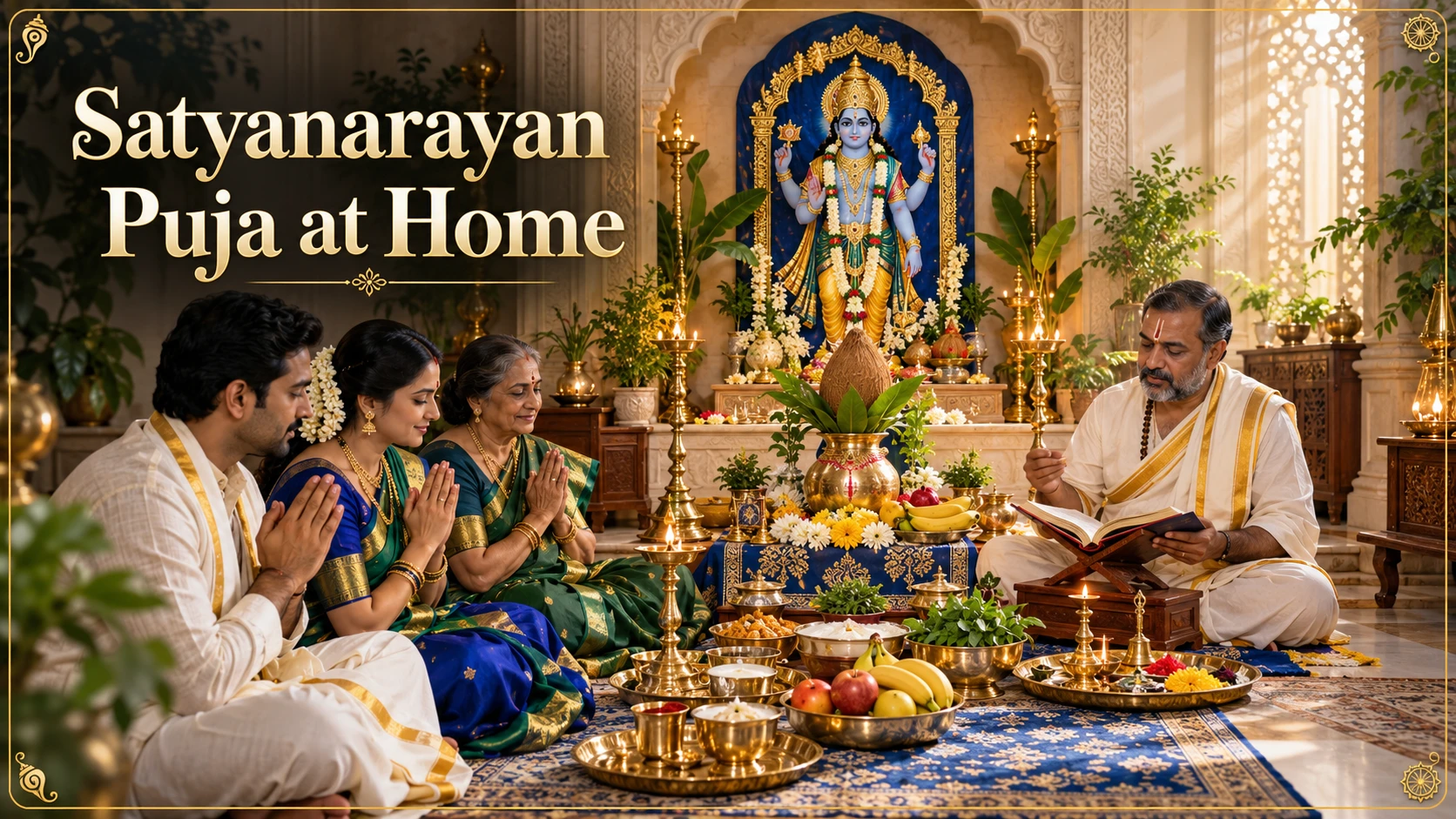
Satyanarayan Puja is a devotional Hindu ritual dedicated to Lord Vishnu in the form of Satyanarayan. It is traditionally performed by families to express gratitude, seek divine blessings, observe a religious vow, or mark an important occasion such as a new home, marriage, birthday, or new beginning.
The puja is commonly associated with the Satyanarayan Katha, which is traditionally recited or heard as part of the ceremony. Many families perform Satyanarayan Puja at home, while others invite a Pandit Ji to conduct the complete ritual according to their family or regional tradition.
In this guide, you will learn what Satyanarayan Puja means, why it is performed, its traditional significance and benefits, the samagri required, the basic puja vidhi, suitable occasions, important rules, and whether it can be performed at home.
Satyanarayan Puja is a form of worship dedicated to Lord Vishnu as Satyanarayan. The name is commonly understood through the words Satya, meaning truth, and Narayan, a name associated with Lord Vishnu.
The central theme of the worship is devotion, truthfulness, gratitude, and faith. The ceremony generally includes the worship of Lord Satyanarayan, preparation of offerings and prasad, and the recitation or listening of the Satyanarayan Katha.
The exact procedure can differ between regions, families and religious traditions. Therefore, the samagri, sequence of rituals, mantras and specific practices may vary.
The Satyanarayan Puja is traditionally associated with the Satyanarayan Vrat Katha in the Skanda Purana, and the Katha forms an important part of the traditional ceremony.
Satyanarayan is worshipped as a form of Lord Vishnu. In Hindu tradition, Lord Vishnu is associated with the preservation and sustenance of the universe.
The name Satyanarayan is therefore closely connected with the idea of truth and righteousness. The stories associated with the Satyanarayan Katha emphasize devotion, keeping one's word, gratitude and the importance of remembering the divine even after achieving success.
For devotees, the puja provides an opportunity to express gratitude and strengthen their spiritual connection with Lord Vishnu.
Families perform Satyanarayan Puja for different religious and personal reasons. Common occasions include:
Expressing gratitude after the fulfillment of a wish or vow
Seeking blessings for peace and harmony in the family
Marking a new beginning
Performing puja after moving into a new home
Celebrating a marriage or anniversary
Beginning a new business or important work
Observing a family religious tradition
Performing a devotional ritual on an auspicious day
The purpose of the puja can therefore be both devotional and ceremonial. It is important to understand that traditional religious benefits are matters of faith and belief rather than scientifically guaranteed outcomes.
The significance of Satyanarayan Puja goes beyond the ritual itself.
The name Satyanarayan is associated with truth. The Katha traditionally reminds devotees of the importance of honesty, keeping promises and maintaining faith.
Many families perform the puja after experiencing an important milestone or the fulfillment of a personal wish. It provides an opportunity to express gratitude for what they have received.
Satyanarayan Puja is often performed with family members gathered together. Listening to the Katha and participating in the rituals can become a shared spiritual experience.
Families may perform the puja during important transitions such as entering a new home, beginning a business or celebrating a significant family occasion.
The Satyanarayan Katha is an important part of the traditional ceremony. Its stories communicate lessons related to faith, truth, gratitude and devotion.
Devotees traditionally associate Satyanarayan Puja with several spiritual and family benefits.
These include:
Seeking Lord Vishnu's blessings
Expressing gratitude
Promoting a sense of peace and devotion
Strengthening family participation in spiritual practices
Beginning an important occasion with prayer
Reflecting on truthfulness and religious duties
Observing a personal or family vow
Some religious traditions also associate the puja with prosperity, harmony and fulfillment of wishes. These should be understood as traditional beliefs, not guaranteed results.
The deeper value of the ceremony for many devotees lies in devotion, gratitude and the teachings conveyed through the Katha.
Satyanarayan Puja is commonly performed on Purnima, or the full moon day. Many families also perform it during other auspicious occasions according to their family tradition.
It may be observed:
On Purnima
During an auspicious family occasion
After Griha Pravesh
During a wedding or anniversary
Before or after starting a new venture
After fulfilling a religious vow
On a personally significant occasion
There is no single universal rule that applies to every family regarding the date and muhurat. Regional traditions and family customs can differ.
If a specific muhurat is important for your ceremony, it is better to consult a reliable Panchang or a knowledgeable Pandit Ji for the date and location of the puja.
Yes. Satyanarayan Puja is commonly performed at home.
A family may perform a simple devotional version themselves, while many families choose to invite a Pandit Ji for the complete ritual and Katha.
If performing the puja at home, prepare the worship space in advance and keep the required samagri, deity image or idol, prasad and Katha book ready.
The exact ritual procedure can vary according to family and regional tradition, so the instructions given by your family priest or religious tradition should take priority where they differ.
The exact Satyanarayan Puja samagri varies according to the tradition being followed. A commonly used checklist may include:
Image or idol of Lord Satyanarayan
Chowki or clean platform
Yellow or clean cloth
Kalash
Coconut
Mango leaves
Gangajal or clean water
Flowers and garland
Tulsi leaves
Roli and kumkum
Akshat (rice)
Turmeric
Sandalwood paste
Incense sticks
Diya and cotton wicks
Camphor
Betel leaves
Supari
Fruits
Seasonal offerings
Sacred thread
Dakshina
Panchamrit is commonly prepared using ingredients such as:
Milk
Curd
Ghee
Honey
Sugar
The exact preparation can vary according to family tradition.
Satyanarayan Puja is commonly associated with a sweet prasad such as sheera or halwa, although the exact preparation varies by region and family tradition.
Keep the prasad ingredients ready before beginning the ceremony so that the puja can proceed smoothly.
The detailed Satyanarayan Puja Vidhi can vary by tradition. A general ceremony may include the following stages:
Clean the room and prepare a suitable place for the puja. Place a clean cloth on the chowki and arrange the deity, kalash and other required items.
The person performing or sponsoring the puja takes a sankalp, or sacred intention, for the ceremony.
The purpose of the puja and relevant details may be stated according to the family tradition.
The ceremony may begin with worship of Lord Ganesha and other deities according to the prescribed tradition.
A kalash is prepared and placed as part of the ritual arrangement. Mango leaves and a coconut are commonly used.
Lord Satyanarayan is worshipped with offerings such as water, flowers, sandalwood, Tulsi and other puja items.
Panchamrit may also be used as part of the traditional worship.
Prepared food, fruits and Satyanarayan Puja prasad are offered to the deity.
The Satyanarayan Katha is traditionally an important part of the ceremony. Families gather to listen to or recite the Katha with devotion.
For the complete Katha and information about arranging the ceremony with a Pandit Ji, you can explore the Satyanarayan Katha service by AstroUni.
After the Katha and offerings, the family performs the aarti according to their tradition.
The prasad is distributed among the family members and other devotees present at the ceremony.
This concludes the main devotional sequence of the puja.
A commonly recited Vishnu mantra associated with the worship is:
Om Namo Bhagavate Vasudevaya.
It is a widely known mantra dedicated to Lord Vishnu.
However, Satyanarayan Puja is not limited to a single mantra. The mantras and recitations used during the complete ceremony can vary according to the puja tradition and the Pandit Ji conducting it.
The exact rules can differ depending on family and regional traditions. However, devotees commonly observe practices such as:
Keep the puja area clean.
Prepare the samagri before starting the ceremony.
Participate in the Katha with attention and devotion.
Follow the instructions of the Pandit Ji if one is conducting the puja.
Prepare the prasad hygienically.
Distribute prasad after the ceremony.
Maintain a respectful and devotional environment.
Follow any fasting or dietary practice according to your family tradition.
There is no need to assume that every rule found online applies universally. Religious practices can differ across communities, so traditional family guidance or a knowledgeable priest can be useful for specific requirements.
Fasting practices differ between families and traditions.
Some devotees observe a vrat or fast on the day of the puja, while others follow a simple sattvic diet.
Therefore, fasting should not be treated as one universal requirement for every person performing or attending Satyanarayan Puja.
If you are observing a specific Satyanarayan Vrat tradition, follow the instructions associated with that tradition.
A simple home worship can be performed by devotees themselves, and many families participate in the puja at home.
However, a complete ritual may involve specific mantras, sankalp, kalash sthapana, offerings and other procedures that vary by tradition.
Families who want the ceremony conducted according to a particular ritual tradition may choose to invite a Pandit Ji.
Satyanarayan Puja refers to the overall worship ceremony, while the Satyanarayan Katha refers to the devotional narrative traditionally recited or heard as part of the ceremony.
The Katha is therefore an important component of the traditional Satyanarayan Puja, rather than simply being another name for every part of the ritual.
If you are specifically looking for a Pandit Ji to conduct the complete Satyanarayan Katha and Puja, you can explore AstroUni's Satyanarayan Katha service.
Yes. Satyanarayan Puja is commonly performed at home. Families may conduct a simple devotional ceremony themselves or invite a Pandit Ji for a more detailed ritual.
Purnima is traditionally considered an important and commonly chosen day for Satyanarayan Puja. Other auspicious occasions may also be selected according to family tradition and Panchang guidance.
Common items include a Lord Satyanarayan image or idol, chowki, kalash, coconut, mango leaves, flowers, Tulsi, fruits, rice, roli, kumkum, turmeric, incense, diya, Panchamrit ingredients and prasad. The exact list varies by tradition.
The puja is traditionally performed to worship Lord Vishnu as Satyanarayan, express gratitude, observe a religious vow and seek divine blessings for peace, prosperity and wellbeing.
The Katha is traditionally a central part of Satyanarayan Puja. However, exact practices and the sequence of the ceremony can differ according to regional and family traditions.
Yes, devotees can perform a simple home worship themselves. For a complete ritual following a particular tradition, many families choose to have a Pandit Ji conduct the ceremony.
Sheera or halwa is commonly prepared as Satyanarayan Puja prasad. Ingredients and preparation methods may vary among families and regions.
Satyanarayan Puja is a devotional worship of Lord Vishnu in the form of Satyanarayan, traditionally associated with truth, devotion, gratitude and faith. It is commonly performed during Purnima, important family occasions, new beginnings and after the fulfillment of a religious vow.
The ceremony generally includes preparation of the puja space, sankalp, worship of Lord Satyanarayan, offerings, Satyanarayan Katha, aarti and distribution of prasad. It can be performed at home, although families may also invite a Pandit Ji when they want the ceremony conducted according to their particular tradition.
Most importantly, the exact procedure, samagri and rules can vary across families and regions. Following a trusted family tradition or guidance from a knowledgeable Pandit Ji can help ensure that the ceremony is performed according to the desired custom.
Copyright © 2026 Astrouni | All Rights Reserved