
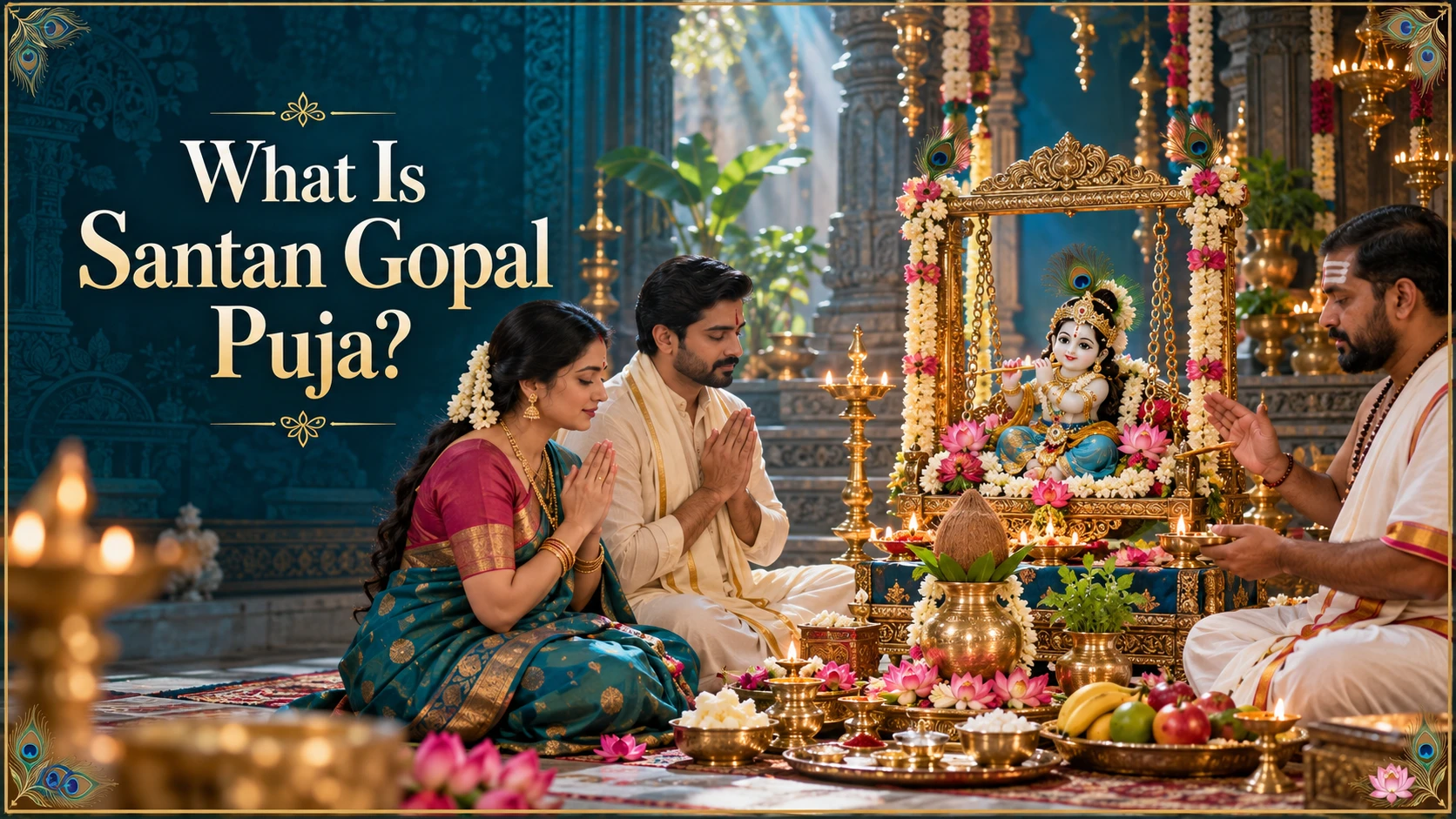
Santan Gopal Puja is a devotional form of Lord Krishna worship centred on his divine child form, known as Bal Gopal or Santan Gopal. Couples and families traditionally perform this puja while praying for the blessing and well-being of children, emotional strength, family harmony and divine guidance during the journey towards parenthood.
The worship may include a sankalp, Bal Gopal dhyan, offerings, the Santan Gopal Mantra, Krishna prayers, stotra path and aarti. The exact procedure can vary according to family tradition, regional practice and the guidance of a qualified priest.
This article explains what Santan Gopal Puja is, its traditional significance and benefits, who may perform it, suitable times and important devotional rules. It does not repeat the complete home-puja procedure, mantra meaning or stotra path already covered in their respective guides.
Santan Gopal Puja is the worship of Lord Krishna in his child form. The term “Santan” means offspring or children, while “Gopal” is one of Lord Krishna’s beloved names. In this form, Krishna represents innocence, parental love, protection, joy and the sacred responsibility of caring for a child.
Devotees may perform the puja while praying for:
The blessing of children
Spiritual strength during fertility-related challenges
A safe and peaceful journey through pregnancy
The health and well-being of existing children
Family harmony and mutual emotional support
Patience, acceptance and divine guidance
These are traditional devotional beliefs. Santan Gopal Puja should never be presented as a guaranteed treatment for infertility, pregnancy complications or any medical condition
Lord Krishna’s childhood occupies a special place in Sanatan tradition. His childhood stories express innocence, joy, affection, protection and the loving relationship between a child and parents.
Worshipping Santan Gopal reminds devotees that parenthood is not only about fulfilling a personal desire. It also involves compassion, responsibility, patience and unconditional care.
The puja’s spiritual significance is connected with:
The worship encourages devotees to develop a personal and loving connection with Krishna in his divine child form.
Couples traditionally offer their desire for children to Lord Krishna through prayer, surrender and a respectful sankalp.
Bal Gopal worship reminds devotees to prepare themselves emotionally and spiritually for the responsibilities associated with raising a child.
The practice encourages sincere effort while accepting that spiritual worship cannot guarantee a particular result or replace responsible action.
When couples pray together, the puja can become a shared spiritual practice based on mutual respect rather than pressure or blame.
The following benefits are based on devotional beliefs and should not be interpreted as medical promises.
Santan Gopal Puja is traditionally performed by couples praying for the blessing of children and seeking Lord Krishna’s grace during their journey towards parenthood.
Fertility concerns can be emotionally challenging. A peaceful spiritual practice may give devotees a structured opportunity for prayer, reflection and emotional support.
The puja includes remembrance of Bal Gopal, devotional offerings and Krishna prayers, helping devotees deepen their relationship with Lord Krishna.
The worship encourages devotees to combine hope with patience, responsibility and acceptance rather than fear or desperation.
Couples may perform the puja together and use the occasion to strengthen mutual understanding, compassion and emotional support.
Cleaning the worship area, lighting a diya, offering flowers and praying calmly can contribute to a peaceful and positive household atmosphere.
Following a regular prayer routine can help devotees develop consistency, concentration and self-discipline.
Parents may also perform the worship while praying for their children’s health, protection, wisdom, happiness and spiritual well-being.
Some families worship Bal Gopal during pregnancy for emotional peace and family well-being. Any fasting, prolonged ritual or physically demanding activity should be adapted to the pregnant devotee’s health.
The symbolism of Bal Gopal reminds devotees that seeking a child’s blessing should be accompanied by a commitment to love, care, protection and responsible parenting.
Santan Gopal Puja may be performed by devotees who approach Lord Krishna with respect and sincere intention. It is traditionally considered by:
Couples praying for child blessings
Married individuals undertaking a personal sankalp
Couples experiencing delays in parenthood
Expectant parents seeking spiritual peace
Parents praying for their children’s well-being
Devotees of Lord Krishna and Bal Gopal
Family members praying for household harmony
A person does not need to be experiencing fertility problems to worship Santan Gopal. The puja may also be performed as an expression of devotion to Krishna or as a prayer for existing children.
Husband and wife may perform Santan Gopal Puja together when both are comfortable and willing. Joint participation can express a shared intention and strengthen emotional support.
However, performing the puja together is not always compulsory for a simple devotional practice. One partner may pray separately if the other is unavailable, unwell or unable to participate.
The worship must never be used to blame, pressure or emotionally burden either partner. Fertility concerns can relate to either or both partners and sometimes remain medically unexplained.
Some families continue Bal Gopal worship during pregnancy as a source of spiritual comfort and prayer for family well-being.
Pregnant devotees should:
Sit in a comfortable position
Avoid prolonged fasting
Avoid physically demanding rituals
Maintain proper nutrition and hydration
Take breaks when required
Follow medical advice
Seek help with elaborate arrangements
A short and peaceful prayer may be more suitable than a lengthy anushthan. Pregnancy-related concerns should always be discussed with a qualified medical professional.
Santan Gopal Puja can be performed on any suitable day with sincere devotion. Traditionally preferred occasions may include:
Thursday
Ekadashi, according to family tradition
Janmashtami
Krishna-related festivals
A day selected by a knowledgeable priest
The beginning of a personal devotional sankalp
An auspicious day chosen according to the family’s circumstances
No single day is universally compulsory for every devotee. Regional traditions and family practices can differ.
Traditionally preferred times include:
Brahma Muhurta
Early morning after bathing
Around sunrise
A peaceful morning period
Evening after lighting a diya
A muhurat selected for a formal priest-guided puja
For regular home worship, consistency and peaceful concentration are generally more important than choosing a complicated time that cannot be maintained.
A specially calculated muhurat is not normally necessary for a simple daily prayer or short home worship.
A muhurat may be considered when:
Performing an elaborate puja
Beginning a formal anushthan
Organising a priest-led ceremony
Conducting a homam or yajna
Following a particular family tradition
A qualified priest or astrologer should consider the devotee’s circumstances before recommending a personalised time. Avoid generic claims that one universal muhurat is suitable for everyone.
The exact procedure varies, but a traditional puja may include:
Purification of the worship area
Invocation of Lord Ganesha
A devotional sankalp
Kalash preparation
Bal Gopal or Krishna dhyan
Offering of water, flowers and Tulsi
Sattvic bhog
Santan Gopal Mantra recitation
Krishna prayers or stotra path
Aarti
Closing prayer
Distribution of prasad
Some formal ceremonies may additionally include abhishek, anushthan, havan or priest-guided mantra jaap.
For the complete practical procedure, read How to Perform Santan Gopal Puja at Home: Step-by-Step Vidhi and Samagri.
A simple arrangement may include:
An image or idol of Bal Gopal
A clean yellow or white cloth
A diya
Fresh flowers
Tulsi leaves, according to tradition
Clean water
Fruits
Mishri or butter
Incense, if suitable
A Tulsi or crystal mala
A clean asana
Aarti items
An expensive arrangement is unnecessary. The worship should not become a financial burden.
A commonly recited prayer in the Santan Gopal tradition is:
ॐ देवकीसुत गोविन्द वासुदेव जगत्पते।
देहि मे तनयं कृष्ण त्वामहं शरणं गतः॥
Om Devaki-Suta Govinda Vasudeva Jagatpate,
Dehi Me Tanayam Krishna Tvamaham Sharanam Gatah.
“O Govinda, divine son of Devaki, O Vasudeva and Lord of the universe, I seek refuge in you. O Krishna, please bless me with a child.”
This prayer expresses surrender and devotion. It should not be interpreted as a promise of conception.
For pronunciation, complete meaning, jaap count and chanting method, read Santan Gopal Mantra: Lyrics, Meaning, Benefits and Chanting Method.
Keep the worship area, puja items and personal clothing clean.
The sankalp should express devotion, family well-being and a sincere prayer for the highest good.
Devotees may follow a peaceful and balanced lifestyle according to their health, personal circumstances and family tradition.
Use accurate and proofread Sanskrit text. Seek guidance if pronunciation or ritual instructions are unclear.
Do not perform the puja because someone has created fear or claimed that misfortune will occur without an expensive ritual.
Reproductive health is a shared and sensitive concern. The worship should create support—not guilt, blame or conflict.
Prayer should focus on the health, welfare and blessing of children rather than gender preference.
Elderly, unwell or pregnant devotees should adapt the procedure according to their health.
Avoid rushing merely to finish a count or ritual. Understanding and attention are more meaningful than hurried performance.
Spiritual practice should complement professional medical evaluation and treatment, not replace them.
Fasting is not universally compulsory for every form of Santan Gopal worship. Practices differ between families and spiritual traditions.
People who are pregnant, unwell, taking medication or following a medically prescribed diet should not undertake fasting without appropriate professional advice.
Devotees may instead follow a simple sattvic diet or perform a peaceful prayer according to their capacity.
No. It would be inaccurate and irresponsible to claim that Santan Gopal Puja guarantees conception or pregnancy.
The puja is a devotional practice that may offer:
Spiritual comfort
Emotional strength
A disciplined prayer routine
Hope and patience
Mutual support between partners
A deeper connection with Lord Krishna
Couples experiencing difficulty conceiving should seek medical evaluation. Depending on the circumstances, both partners may require assessment.
| Practice | Main form | Common devotional purpose |
|---|---|---|
| Santan Gopal Puja | Structured worship with sankalp and offerings | Complete devotional ceremony |
| Santan Gopal Mantra | Short sacred prayer repeated during jaap | Daily chanting and meditation |
| Santan Gopal Stotra | Extended hymn praising Lord Krishna | Structured recitation and devotion |
| Santana Gopala Homam | Priest-guided fire ritual | Formal Vedic worship |
These practices are related but should not be treated as identical.
To understand the longer devotional recitation, read Santan Gopal Stotra in Hindi: Meaning, Benefits and Path Vidhi.
Some devotees follow daily mantra chanting, while others arrange a structured puja with a priest. The appropriate practice depends on personal faith, available time, health, family tradition and spiritual guidance.
Those specifically researching chanting during conception or pregnancy may read Santan Gopal Mantra for Pregnancy and Conceiving: Meaning and Chanting Rules.
The worship is spiritual, not a replacement for fertility assessment, prenatal care or medical treatment.
Copyright © 2026 Astrouni | All Rights Reserved