
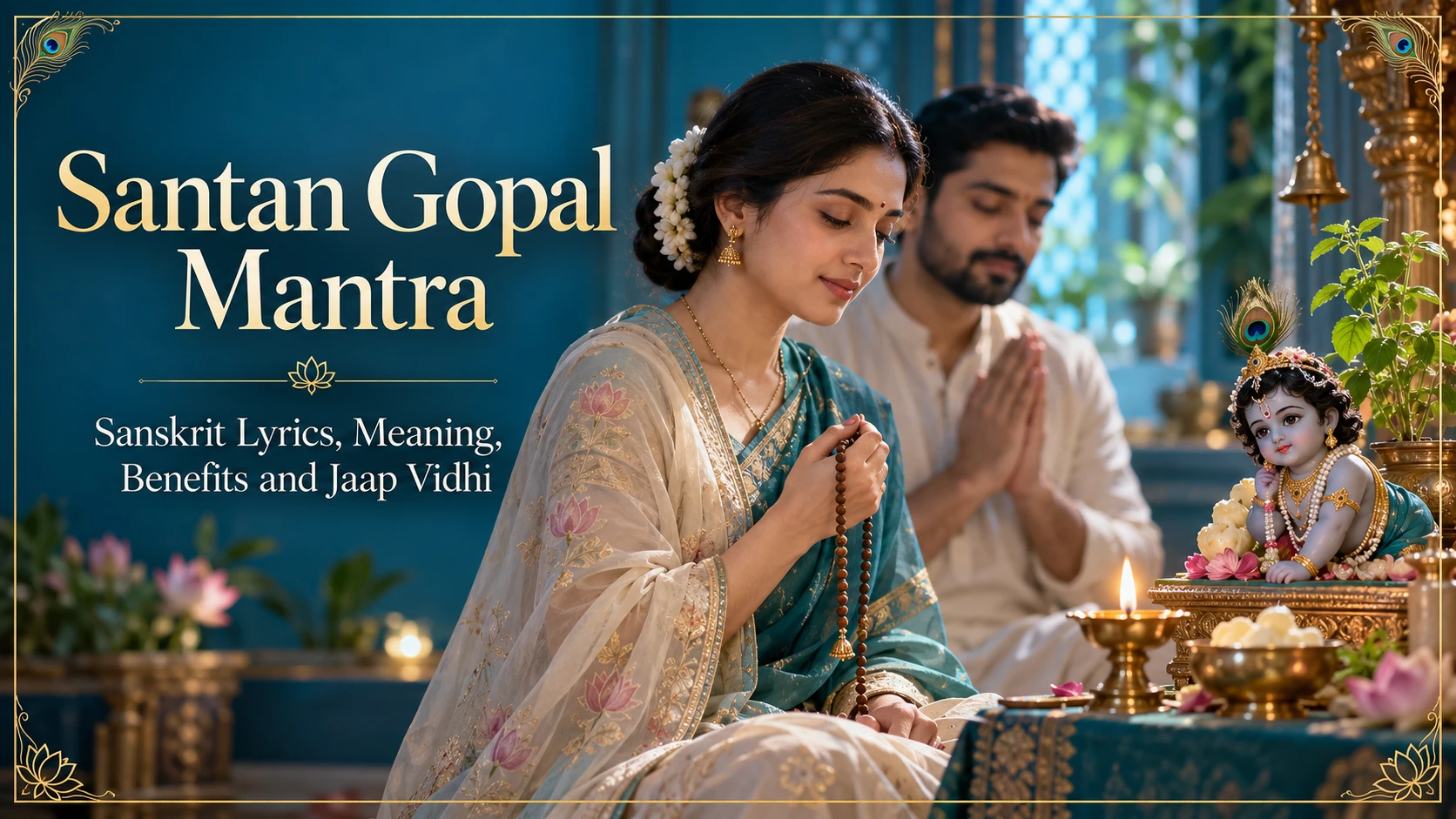
The Santan Gopal Mantra is a devotional prayer dedicated to Lord Krishna in his child form, known as Bal Gopal or Santan Gopal. Traditionally, devotees chant this mantra while praying for the blessing and well-being of children, family happiness, and divine guidance.
The mantra is especially associated with prayers for santan (children) and is recited with faith, devotion, and surrender to Lord Krishna. Understanding the meaning of the mantra can make the chanting practice more meaningful rather than simply repeating the words.
In this guide, you will find the Santan Gopal Mantra in Sanskrit, its meaning, traditional benefits, and the complete Santan Gopal Mantra Jaap Vidhi. The guide also explains how to approach the chanting practice with consistency and devotion.
The Santan Gopal Mantra is a spiritual practice and should not be considered a guaranteed method of conception or a substitute for appropriate medical care.
Sanskrit:
ॐ देवकीसुत गोविन्द वासुदेव जगत्पते।
देहि मे तनयं कृष्ण त्वामहं शरणं गतः॥
English Transliteration:
Om Devaki-Suta Govinda Vasudeva Jagatpate,
Dehi Me Tanayam Krishna Tvamaham Sharanam Gatah.
| Sanskrit phrase | Meaning |
|---|---|
|
Sacred primordial sound |
|
Son of Devaki |
|
A revered name of Lord Krishna |
|
Vasudeva; a name associated with Lord Krishna |
|
Lord of the universe |
|
Please grant me |
|
A child or offspring |
|
Lord Krishna |
|
I seek you / I turn toward you |
|
I have taken refuge in you |
हे देवकीसुत भगवान गोविंद, हे वासुदेव, हे संपूर्ण जगत के स्वामी श्रीकृष्ण! मैं आपकी शरण में आया/आई हूँ। कृपया मुझे संतान का आशीर्वाद प्रदान करें।
इस मंत्र का भाव केवल संतान की इच्छा तक सीमित नहीं है। यह भगवान श्रीकृष्ण की शरण में जाने, श्रद्धा रखने, धैर्य बनाए रखने और ईश्वर पर विश्वास करने की भावना से जुड़ा है।
The devotee addresses Lord Krishna as the son of Devaki, Govinda, Vasudeva and the Lord of the universe. The devotee seeks Krishna's refuge and humbly prays for the blessing of a child.
The deeper devotional meaning is connected with faith, surrender, patience and divine guidance.
The following benefits come from devotional and traditional beliefs. They should not be understood as guaranteed medical outcomes.
1. Prayer for the Blessing of Children
Devotees traditionally chant the Santan Gopal Mantra while praying for the blessing and well-being of children.
2. Strengthens Devotion to Lord Krishna
Regular mantra chanting can become a way of remembering Lord Krishna and developing devotion, humility and spiritual discipline.
3. Encourages Patience and Faith
The mantra's emphasis on surrender can help devotees approach difficult periods with patience rather than fear or excessive worry.
4. Creates a Regular Spiritual Routine
Chanting the mantra at a fixed time each day can create a consistent routine for prayer, reflection and devotion.
5. Supports Family Harmony
When family members pray together with mutual respect, the practice can become a shared spiritual activity and source of emotional support.
6. Encourages Prayer for Children's Well-Being
Parents may also recite the mantra while praying for the health, happiness, protection and well-being of their children.
7. Develops a Sense of Surrender
The words “I have taken refuge in you” express surrender to Lord Krishna. This can encourage devotees to combine prayer with patience and responsible action.
Santan Gopal Mantra Jaap refers to the devotional practice of repeatedly chanting the mantra with attention and श्रद्धा (faith). It can be included in a daily prayer routine at home without requiring an elaborate ritual.
The most important part of jaap is to maintain a peaceful environment, pronounce the mantra carefully, and keep your attention on the prayer rather than treating the repetition as a mechanical task.
Choose a clean and quiet place where you can sit comfortably without frequent interruptions. Take a few moments to settle yourself and calm your mind before beginning the jaap.
If you wish, you can keep an image or idol of Bal Gopal in front of you and light a diya according to your usual devotional practice.
Before beginning, you may take a simple sankalp, or personal devotional intention.
You can mentally state why you are performing the jaap and resolve to complete the number of repetitions you have chosen. Keep the intention simple and sincere.
For example, you may make a personal resolve to chant the Santan Gopal Mantra a fixed number of times each day for a particular period.
Sit in a comfortable position with your back reasonably straight. You may sit on a clean mat or cloth.
Close your eyes for a moment, take a few calm breaths, and bring your attention to the mantra.
If you want to keep track of your repetitions, you can use a japa mala. A traditional 108-bead mala can be used when you choose to complete 108 repetitions.
Move one bead for each repetition while keeping your attention on the mantra. If you are not using a mala, you can count the repetitions mentally or use another simple counting method.
Begin chanting the Santan Gopal Mantra slowly and clearly.
You may chant it aloud, softly, or mentally according to your personal devotional practice. Focus on the words, pronunciation, and meaning rather than rushing through the repetitions.
If you are still learning the mantra, first practice the pronunciation before beginning a longer jaap session.
Try to maintain a comfortable and consistent rhythm throughout the chanting.
There is no need to chant extremely quickly to complete a particular number. A steady pace can make it easier to remain attentive and complete the jaap with concentration.
If your mind becomes distracted, gently bring your attention back to the mantra and continue.
Continue until you have completed the number of repetitions you decided upon.
Depending on your routine, this may be 11, 21, 108, or another number of repetitions. The appropriate count can depend on your personal devotional practice and the intention with which you are chanting.
For beginners, it can be more practical to establish a consistent routine rather than choosing a number that is difficult to maintain.
After completing the jaap, sit quietly for a few moments and offer your prayer to Lord Krishna.
You may express gratitude and your personal wishes or intentions. If you are praying for family or children, you can include those intentions in your closing prayer.
This completes the basic Santan Gopal Mantra Jaap Vidhi.
There is no single compulsory number of repetitions for every devotee. The appropriate count may depend on personal practice, family tradition or guidance received for a formal spiritual practice.
Commonly used counts include:
| Repetitions | Suitable for |
|---|---|
|
Short daily prayer |
|
Regular and manageable practice |
|
A longer devotional session |
|
One complete mala |
If you are beginning the practice, 11 or 21 repetitions can provide a simple routine. Devotees who already follow a mala-based practice may choose 108 repetitions.
The important point is to chant with attention rather than rushing to complete a large number.
The mantra can be chanted at any peaceful and consistent time.
Traditionally preferred times include:
Early morning after bathing
Brahma Muhurta
Around sunrise
Evening after lighting a diya
Thursday devotional practice
Krishna-related festivals or observances
For most people, consistency is more practical than searching for a complicated “perfect” time.
Choose a time when you can sit peacefully without unnecessary distractions.
Facing east or north is traditionally preferred for many Hindu prayer practices.
However, a separate temple room is not compulsory. A clean, peaceful corner of your home can be used for daily mantra chanting.
The important thing is to maintain a respectful and comfortable prayer environment.
A simple home practice may include:
Image or idol of Bal Gopal
Clean cloth
Diya
Fresh flowers
Tulsi leaves according to tradition
Fruits or a simple sattvic offering
Tulsi mala, if required
Clean asana
Water
You do not need an elaborate setup for ordinary daily chanting. Cleanliness, devotion and consistency are more important than expensive पूजा सामग्री.
For a simple devotional practice, keep these points in mind:
Keep the prayer area clean.
Wear clean and comfortable clothes.
Chant at a consistent time when possible.
Pronounce the mantra carefully.
Understand the basic meaning of the mantra.
Choose a repetition count you can maintain.
Avoid rushing through the mantra.
Keep distractions away during chanting.
Maintain a respectful and sincere intention.
Follow your family or spiritual tradition for formal rituals.
Use diyas and incense safely.
Do not treat the mantra as a guaranteed fertility treatment.
Chanting Without Understanding the Meaning
Knowing the basic meaning can help you approach the mantra with greater awareness and devotion.
Rushing Through the Repetitions
Completing 108 repetitions quickly is not more meaningful simply because the number is larger. Chant at a comfortable pace.
Frequently Changing Your Sankalp
If you have chosen a particular count and duration for a personal sankalp, try to follow it consistently.
Expecting Guaranteed Results
Mantra chanting is a devotional practice. It should not be presented as a guaranteed method of conception or as a substitute for medical care.
Blaming One Partner
Fertility difficulties can have many causes. Neither partner should be blamed or shamed.
Ignoring Medical Advice
Prayer may be part of a person's spiritual and emotional support system, but it does not replace appropriate medical consultation, diagnosis or treatment.
Although both are associated with devotion to Lord Krishna and prayers for children, they are different practices.
| Santan Gopal Mantra | Santan Gopal Puja |
|---|---|
|
A structured worship ceremony |
|
May involve several ritual stages |
|
May require complete puja samagri |
|
Can be performed personally or with priestly guidance |
|
Usually follows a more detailed ritual procedure |
If you want to learn about the more elaborate worship ceremony, you can explore Santan Gopal Puja separately on Astrouni.
The Santan Gopal Mantra is a devotional prayer to Lord Krishna in which devotees traditionally seek his blessings for children, family well-being and spiritual strength.
A commonly recited Santan Gopal Mantra is:
ॐ देवकीसुत गोविन्द वासुदेव जगत्पते।
देहि मे तनयं कृष्ण त्वामहं शरणं गतः॥
The devotee addresses Lord Krishna as Devaki's son, Govinda and Lord of the universe, seeks his refuge and humbly prays for the blessing of a child.
You may choose 11, 21, 51 or 108 repetitions according to your personal practice. If you are following a formal spiritual practice, follow the count prescribed by your spiritual guide.
Early morning is traditionally preferred, but any peaceful and consistent time can be suitable for personal devotional practice.
A Tulsi mala is traditionally associated with Krishna worship. A mala is useful for counting but is not compulsory for simple chanting.
Yes. Couples can chant together or separately according to their comfort, schedules and devotional practice.
No. A spiritual mantra should not be presented as a guaranteed method of conception. People facing fertility concerns should also seek appropriate professional medical guidance.
A priest is generally not required for simple personal chanting at home. For a formal anushthan or elaborate ritual, appropriate guidance from a knowledgeable priest or spiritual teacher can be helpful.
The Santan Gopal Mantra is a devotional prayer to Lord Krishna that is traditionally recited while seeking blessings for children and family well-being. Its words express devotion, surrender, and a humble prayer to Lord Krishna.
Understanding the meaning of the Santan Gopal Mantra helps devotees connect with the prayer more deeply, while its traditionally described benefits are associated with devotion, patience, spiritual discipline, and hope during the journey towards parenthood.
For the Santan Gopal Mantra Jaap Vidhi, devotees can create a clean and peaceful space, sit comfortably before Bal Gopal, take a sincere sankalp, and chant the mantra with attention and devotion. The focus should be on understanding the prayer and maintaining a consistent spiritual practice rather than simply completing a fixed number of repetitions.
The mantra can be an important part of a devotee's spiritual routine, but it should be approached with faith and patience rather than expectations of guaranteed results. For concerns related to conception, pregnancy, or reproductive health, spiritual practice should be complemented by appropriate medical guidance.
Copyright © 2026 Astrouni | All Rights Reserved