
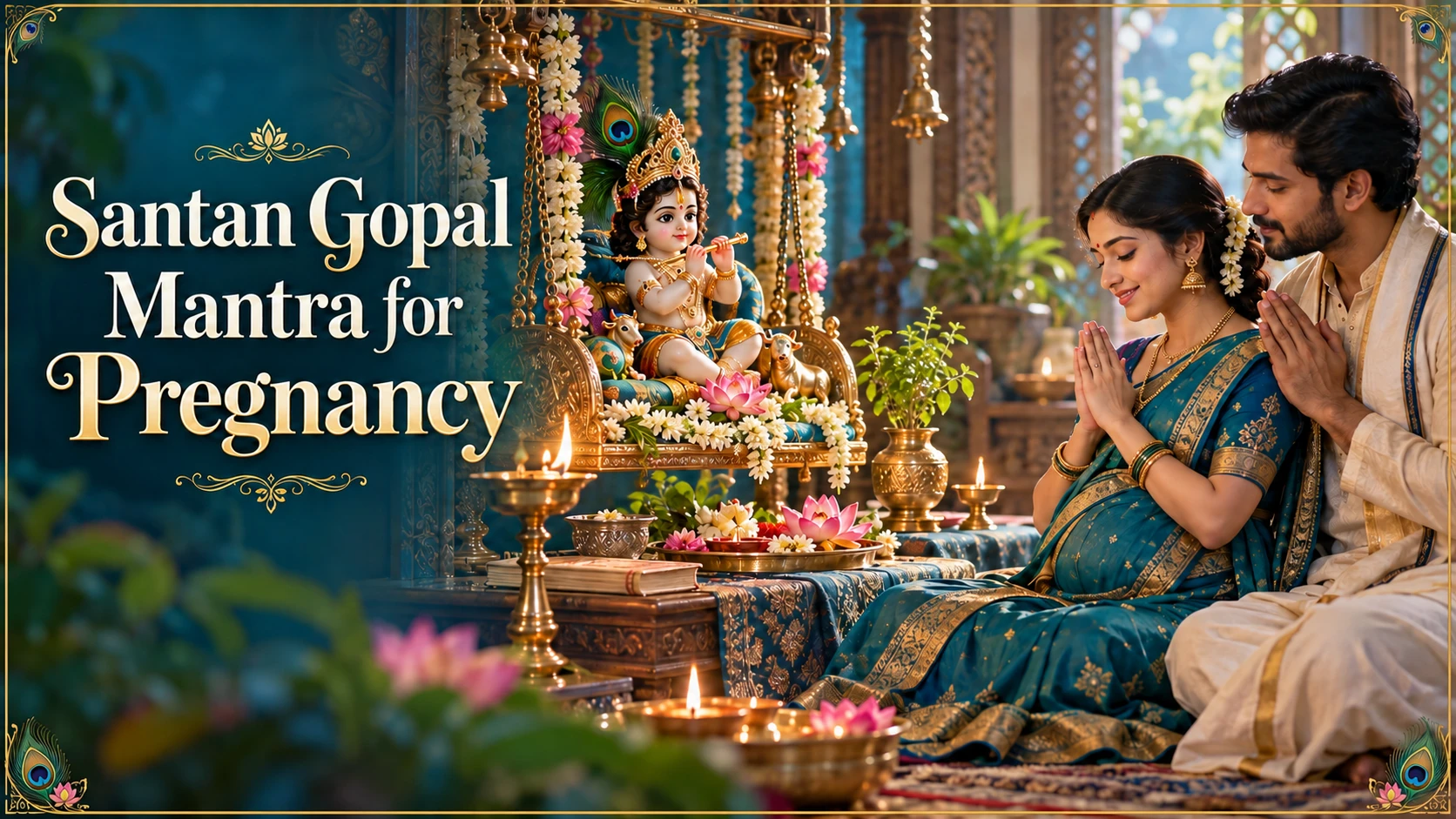
The Santan Gopal Mantra for pregnancy is a devotional prayer offered to Lord Krishna in his divine child form, known as Bal Gopal or Santan Gopal. Couples traditionally recite this prayer while seeking child blessings, emotional strength and family well-being. Expectant parents may also include it in gentle Krishna worship during pregnancy.
This article explains the mantra’s Sanskrit text, transliteration, Hindi and English meaning, traditional significance and suitable chanting rules. It also makes an important distinction between chanting the Santan Gopal Mantra for conceiving and reciting it after pregnancy has begun.
The mantra should be approached with faith, patience and emotional balance. It is not a fertility treatment, pregnancy protection guarantee or substitute for medical care.
The Santan Gopal Mantra is a prayer to Lord Krishna as Devaki’s divine son and the Lord of the universe. Through its words, devotees seek refuge in Krishna and humbly express their prayer for the blessing of a child.
“Santan” means children or offspring, while “Gopal” is a revered name of Lord Krishna. Santan Gopal therefore represents the child form of Krishna associated with innocence, parental affection, hope, protection and family happiness.
The mantra is traditionally recited by:
Couples praying for child blessings
Individuals seeking emotional strength while trying to conceive
Expectant parents praying for peace and family well-being
Parents praying for their children
Devotees of Bal Gopal and Lord Krishna
Different families and spiritual traditions may follow different methods. Formal Sankalp, Nyasa or a large mantra Anushthan should be undertaken with appropriate guidance.
ॐ देवकीसुत गोविन्द वासुदेव जगत्पते।
देहि मे तनयं कृष्ण त्वामहं शरणं गतः॥
Om Devaki-Suta Govinda Vasudeva Jagatpate,
Dehi Me Tanayam Krishna Tvamaham Sharanam Gatah.
Pronunciation may vary slightly across regions and traditions. Devotees planning a formal Anushthan should verify the accepted pronunciation with a knowledgeable Sanskrit teacher or spiritual guide.
हे देवकीनंदन भगवान गोविंद, हे वासुदेव, हे संपूर्ण संसार के स्वामी श्रीकृष्ण! मैं आपकी शरण में आया/आई हूं। कृपया मुझे संतान का आशीर्वाद प्रदान करें।
यह मंत्र भगवान श्रीकृष्ण के प्रति श्रद्धा और समर्पण व्यक्त करता है। इसमें भक्त अपनी प्रार्थना भगवान के सामने रखता है और धैर्य, आशा तथा आध्यात्मिक शक्ति के लिए उनकी शरण ग्रहण करता है।
“O Lord Govinda, divine son of Devaki, O Vasudeva and Lord of the universe, I seek refuge in you. O Krishna, please bless me with a child.”
The deeper message of the mantra is surrender. Rather than treating prayer as a demand for a guaranteed outcome, it encourages devotees to approach Krishna with humility, patience, responsibility and trust.
In Hindu devotional tradition, Bal Gopal represents divine childhood, parental affection and family joy. Couples may chant the Santan Gopal Mantra for conceiving as a spiritual expression of hope while praying for child blessings.
The practice may help devotees establish:
A regular period of prayer and reflection
Emotional calmness during a sensitive journey
Shared spiritual support between partners
Patience and acceptance
Deeper devotion to Lord Krishna
A peaceful and positive home environment
These are spiritual and emotional purposes. Chanting cannot guarantee conception or treat a reproductive-health condition.
Couples experiencing difficulty conceiving should consult qualified healthcare professionals. Evaluation may involve either or both partners, and neither person should be blamed.
Yes. Some devotees continue Krishna worship and peaceful mantra recitation during pregnancy as a source of faith, emotional support and family prayer.
However, chanting during pregnancy should remain gentle and comfortable. An expectant mother should not feel pressured to perform long sittings, strict fasting or physically demanding rituals.
A pregnant devotee may:
Chant a small, manageable number of repetitions
Listen to a calm and correctly pronounced recitation
Perform mental Jaap while resting
Pray together with her partner or family
Sit on a chair or supported seat instead of the floor
Pause whenever she feels tired, dizzy or uncomfortable
Medical advice, prescribed treatment, adequate nutrition, hydration, rest and prenatal appointments must always take priority.
| Before conception | During pregnancy |
|---|---|
| Couples may chant individually or together | The expectant mother may chant, listen or practise mental Jaap |
| A regular Sankalp may be followed according to capacity | Comfort and medical safety should guide the routine |
| A mala may be used for maintaining the count | A mala is optional; a small count may be more suitable |
| Simple fasting may be followed only when medically appropriate | Strict or prolonged fasting should not be undertaken without medical advice |
| Longer sitting may be possible for some devotees | Prolonged sitting and uncomfortable postures should be avoided |
| The prayer may focus on child blessings and emotional strength | The prayer may focus on peace, family welfare and the well-being of mother and baby |
Neither form of practice provides a guaranteed medical outcome.
The following are traditionally associated spiritual benefits rather than scientifically guaranteed fertility or pregnancy outcomes.
Slow and mindful chanting may help devotees settle their thoughts during emotionally stressful periods.
The mantra invokes Krishna as Devaki’s son and encourages a loving devotional connection with his child form.
Couples traditionally use the mantra to express their prayer for children and family happiness.
Chanting at a consistent time can establish discipline and provide a dedicated period for prayer and reflection.
When couples pray together, the practice may encourage patience, compassion and shared emotional support.
The phrase expressing refuge in Krishna reminds devotees to balance personal effort with humility and acceptance.
Expectant parents may use gentle recitation as a devotional way to seek emotional peace and family well-being.
A respectful prayer routine involving cleanliness, calmness and gratitude may contribute to a more peaceful household.
Traditionally preferred times include:
Early morning during Brahma Muhurta
After bathing and completing morning prayers
Around sunrise
Thursday morning
During a Krishna-related observance
In the evening after lighting a diya
At a regular daily time suitable for the devotee
Consistency is generally more important than selecting a complicated Muhurat for simple daily chanting.
During pregnancy, choose a time when the expectant mother feels rested and comfortable. There is no benefit in forcing a difficult schedule.
Choose a clean, quiet and well-ventilated prayer area. Facing east or north is traditionally preferred when convenient, but comfort should take priority during pregnancy.
The mantra may be chanted:
In a home mandir
Before an image or idol of Bal Gopal
In a peaceful prayer corner
At a Krishna temple
During a priest-guided Santan Gopal Puja
Mentally while resting, if physical worship is uncomfortable
Elaborate Puja Samagri is not required for daily mantra chanting. You may keep:
An image or idol of Bal Gopal
A clean yellow, white or blue cloth
A diya
Fresh flowers
Tulsi leaves, according to tradition
Fruit, butter or mishri as Bhog
A small vessel of clean water
A Tulsi or crystal mala
A clean and comfortable seat
Pregnant devotees should avoid smoke from incense if it causes nausea, breathing discomfort or sensitivity.
Choose a peaceful area and arrange Bal Gopal’s image or idol respectfully.
Wear clean and comfortable clothing. No particular colour is compulsory for simple personal chanting.
Light a diya in a stable place. Incense is optional and should only be used when suitable for everyone in the household.
Offer flowers, fruit, mishri or butter according to your capacity and tradition.
Begin with a short prayer to Lord Ganesha for the peaceful completion of the practice.
A simple Sankalp may be:
“I am chanting the Santan Gopal Mantra with devotion, seeking Lord Krishna’s grace, emotional strength, family well-being and child blessings. May this practice be completed respectfully and for the highest good.”
A formal Sanskrit Sankalp should be undertaken with proper guidance.
Recite the mantra clearly and without rushing:
ॐ देवकीसुत गोविन्द वासुदेव जगत्पते।
देहि मे तनयं कृष्ण त्वामहं शरणं गतः॥
A Tulsi or crystal mala may help maintain the count. Traditionally, the index finger is not used for moving the beads.
Pray for wisdom, emotional strength, family harmony and the ability to follow appropriate spiritual and medical guidance.
Offer the prepared Bhog respectfully and share it as Prasad.
Pregnancy chanting should be peaceful and free from physical strain.
Sit on a chair, bed or supported cushion. It is not compulsory to sit on the floor.
A small image of Bal Gopal, a flower and a safely placed diya are sufficient. An elaborate setup is unnecessary.
Settle comfortably before chanting. Stop if you feel breathless, dizzy, nauseous or tired.
Begin with 11 repetitions or another count that feels comfortable. Quality and calmness are more important than completing a large number.
If speaking or sitting becomes tiring, listen to a gentle recitation or remember the mantra silently.
Offer gratitude and pray for wisdom, peace, family support and appropriate care throughout pregnancy.
There is no universally compulsory count for every devotee.
| Jaap count | Suggested practice |
|---|---|
| 11 times | Short daily prayer or gentle pregnancy practice |
| 21 times | Manageable regular chanting |
| 51 times | Longer practice when health and time permit |
| 108 times | One complete mala for experienced devotees |
| Mental remembrance | Suitable when physical chanting is tiring |
Pregnant devotees should not force themselves to complete 108 repetitions. The count should be adapted to comfort, energy and medical circumstances.
Some devotees follow the mantra:
Daily as part of Krishna worship
For 21 days
For 40 days
For 108 days
For a duration recommended by their spiritual guide
Throughout pregnancy in a gentle and adaptable form
These durations are devotional disciplines. None of them guarantees conception, a complication-free pregnancy or a particular outcome.
A fixed Sankalp should not create anxiety. If illness, travel, pregnancy discomfort or an emergency interrupts the routine, resume peacefully when appropriate or seek spiritual guidance.
Keep the prayer area clean.
Chant with a peaceful and respectful intention.
Pronounce the mantra carefully.
Choose a count that can be maintained without stress.
Avoid hurried or mechanical repetition.
Do not undertake extreme fasting.
Do not ignore hunger, weakness, dizziness or medical advice.
Do not treat chanting as fertility or prenatal treatment.
Do not discontinue prescribed medication.
Avoid fear-based spiritual claims.
Do not pray for or demand a child of a particular sex.
Do not blame either partner for difficulty conceiving.
Adapt the practice to pregnancy-related health needs.
Seek qualified guidance for a formal Anushthan.
Fasting is not compulsory for simple Santan Gopal Mantra chanting.
Couples trying to conceive should consider their health before following any fast. Pregnant devotees should not undertake strict fasting without explicit medical advice because proper nutrition and hydration are important.
Devotion should not require actions that endanger physical health. A sattvic meal, mindful conduct and sincere prayer may be followed according to individual circumstances.
Yes. Both partners may chant together when comfortable. Shared prayer can encourage mutual support and remind couples that the journey should not become a source of blame or emotional pressure.
If schedules differ, either partner may maintain an individual practice. One partner’s inability to chant should not be treated as a spiritual failure.
Yes. The husband may chant the Santan Gopal Mantra while praying for his partner’s emotional well-being, family harmony and the appropriate care of mother and baby.
He may also support the expectant mother by:
Sharing household responsibilities
Attending medical appointments
Helping maintain a calm environment
Ensuring proper rest and nutrition
Avoiding pressure concerning rituals or chanting counts
Devotional responsibility should be accompanied by practical care.
Yes. Listening to a calm and correctly pronounced recitation can be included in devotional practice, especially when an expectant mother feels tired or cannot sit for a formal Jaap.
However, the audio should be played at a comfortable volume. There is no requirement to play the mantra loudly or continuously.
Practices differ among families and spiritual traditions. Some devotees continue mental remembrance or personal chanting, while others pause formal altar rituals.
Follow your personal belief and family or spiritual guidance without fear, shame or pressure. Menstruation is a natural biological process and should not be treated as a reason for humiliation.
No. The Santan Gopal Mantra is a devotional prayer and cannot guarantee conception.
Fertility can be affected by many medical, biological and age-related factors. Couples who have concerns should seek evaluation from qualified healthcare professionals. Both partners may require assessment.
Be cautious of anyone who:
Guarantees pregnancy through a ritual
Creates fear about infertility
Blames one partner
Advises stopping medical treatment
Demands unnecessary expenditure
Promises a child of a particular sex
Spiritual practice may provide faith and emotional support, but honest guidance must respect medical reality.
| Practice | Main form | Typical use |
|---|---|---|
| Santan Gopal Mantra | Short sacred prayer | Daily Jaap and meditation |
| Santan Gopal Stotra | Extended devotional hymn | Structured reading and Krishna worship |
| Santan Gopal Puja | Complete worship ceremony | Sankalp, offerings, mantra and Aarti |
| Santana Gopala Homam | Priest-guided fire ritual | Formal ritual worship |
For complete Sanskrit lyrics, general meaning and the full Jaap procedure, read the detailed Santan Gopal Mantra guide.
Those seeking structured worship may learn about Santan Gopal Puja for child blessings.
The Santan Gopal Mantra is traditionally included in Krishna worship during pregnancy. It may be recited gently for devotion, emotional peace and family well-being, but it does not replace prenatal healthcare.
Yes. Couples may chant it as a devotional prayer for child blessings and emotional strength while continuing appropriate medical evaluation or fertility treatment.
Eleven or 21 repetitions may provide a manageable daily practice. No fixed count is compulsory, and pregnant devotees should prioritise comfort and health.
No. A complete mala contains 108 beads, but 108 repetitions are not mandatory. A calm and sustainable practice is preferable to a count that causes strain.
The mantra may be included in regular Krishna worship at any suitable time. A formal fixed-duration Sankalp should be undertaken according to personal capacity and appropriate guidance.
Choose a peaceful time when the expectant mother feels rested. Early morning is traditionally preferred, but comfort and consistency matter more than following a difficult schedule.
Bathing is traditionally preferred before formal worship. When health, pregnancy discomfort or other circumstances make it difficult, personal cleanliness and sincere mental remembrance may be followed according to one’s tradition.
Mental remembrance or quiet listening may be practised while resting when sitting is uncomfortable. Formal Jaap is traditionally performed while seated, but health should take priority during pregnancy.
Yes. Couples may chant together or separately. The practice should promote mutual support rather than pressure.
Yes. Listening at a calm volume can be part of devotional practice, particularly when active recitation feels tiring.
No. No mantra can guarantee a safe pregnancy. Regular prenatal appointments, prescribed medication, nutrition and professional medical advice remain essential.
The mantra should not be used to demand a child of a particular sex. Such claims are spiritually inappropriate and may also conflict with laws prohibiting sex selection.
No. Do not stop medical testing, medication or fertility treatment without consulting the qualified professional responsible for your care.
The Santan Gopal Mantra for pregnancy and conceiving is a devotional prayer to Lord Krishna’s child form. Couples may recite it while seeking child blessings, emotional strength and family harmony, while expectant parents may include it in gentle Krishna worship during pregnancy.
The practice should remain peaceful, manageable and free from fear. Pregnant devotees should avoid strict fasting, physical strain and excessive chanting counts. Couples trying to conceive should continue appropriate medical evaluation without blaming either partner.
Faith and healthcare do not need to oppose each other. Devotional prayer may provide hope and emotional support, while qualified medical care provides the assessment and treatment necessary for responsible fertility and pregnancy support.
Copyright © 2026 Astrouni | All Rights Reserved